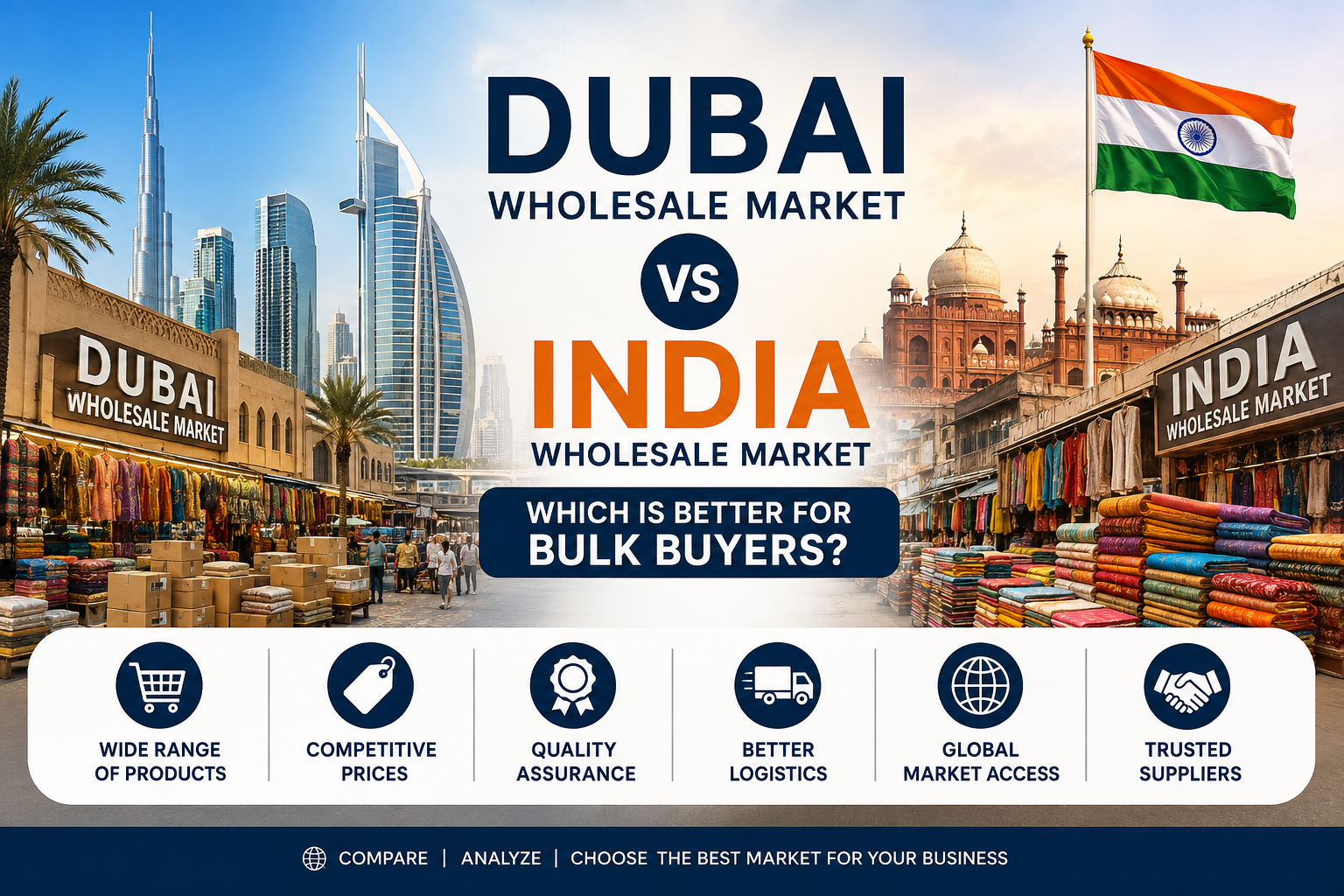
Dubai Wholesale Market vs India Wholesale Market: Which One Should You Choose?
When it comes to wholesale sourcing, Dubai and India are two important markets for retailers, resellers, importers, and international buyers. Both markets offer a wide range of products, competitive wholesale prices, and access to large supplier networks.
Understanding the Dubai Wholesale Market vs India Wholesale Market can help businesses compare product variety, pricing, manufacturing options, logistics, and access to international markets before choosing the right sourcing destination.
However, the two markets work very differently.
India is particularly strong in manufacturing and specialized production, with major wholesale and manufacturing hubs such as Surat, Delhi, Mumbai, Tiruppur, Ludhiana, and Jaipur. (garmentindustry.in)
Dubai, on the other hand, is known for its international trading environment, import and re-export activity, and access to suppliers serving customers across the Middle East and beyond. Dubai’s 2024 trade with India alone reached AED 139.4 billion, demonstrating the strength of the commercial relationship between the two markets. (DMO)
So, which market is better?
The answer depends on what you are buying, where your customers are located, your order size, delivery requirements, and whether you need manufacturing or ready-to-ship wholesale products.
For retailers and importers, understanding the Dubai Wholesale Market vs India Wholesale Market can make it easier to choose the right supplier and sourcing strategy.
Dubai Wholesale Market
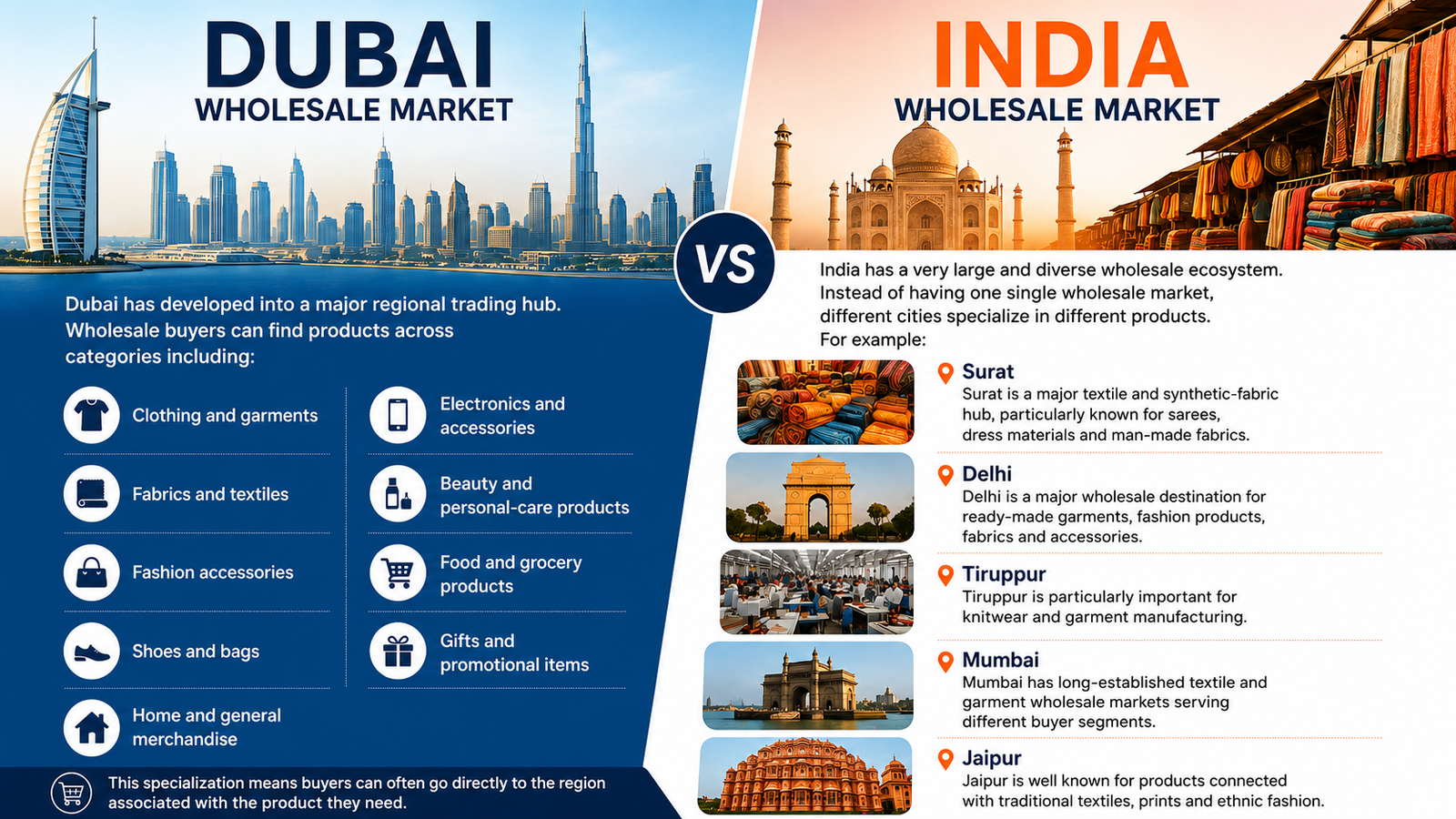
Dubai has developed into a major regional trading hub. Wholesale buyers can find products across categories including:
- Clothing and garments
- Fabrics and textiles
- Fashion accessories
- Shoes and bags
- Home and general merchandise
- Electronics and accessories
- Beauty and personal-care products
- Food and grocery products
- Gifts and promotional items
When comparing the Dubai Wholesale Market vs India Wholesale Market, Dubai offers an advantage for buyers who want access to ready-stock products and international trading networks
Areas such as Deira, Bur Dubai, Al Ras, and other commercial districts have long-established wholesale businesses. Dubai’s wholesale ecosystem also includes larger trading and logistics operations connected to the city’s international supply chain. (Estate Magazine).
For businesses selling in the UAE, GCC, Africa, or other international markets, Dubai can be attractive because buyers can source products while operating close to major logistics and trading networks.
India Wholesale Market
India has a very large and diverse wholesale ecosystem. Instead of having one single wholesale market, different cities specialize in different products.
For example:
Surat
Surat is a major textile and synthetic-fabric hub, particularly known for sarees, dress materials and man-made fabrics. (garmentindustry.in)
Delhi
Delhi is a major wholesale destination for ready-made garments, fashion products, fabrics and accessories.
Tiruppur
Tiruppur is particularly important for knitwear and garment manufacturing.
Mumbai
Mumbai has long-established textile and garment wholesale markets serving different buyer segments.
Jaipur
Jaipur is well known for products connected with traditional textiles, prints and ethnic fashion.
This specialization means buyers can often go directly to the region associated with the product they need.
The Dubai Wholesale Market vs India Wholesale Market comparison shows that India is particularly attractive for buyers looking for manufacturing, customized products and specialized textiles.
Dubai vs India Wholesale Market – Quick Comparison
| Feature | Dubai Wholesale Market | India Wholesale Market |
|---|---|---|
| Product Variety | Very High | Very High |
| Manufacturing | Moderate | Excellent |
| Wholesale Trading | Excellent | Excellent |
| International Buyers | Excellent | Excellent |
| Ready-to-Ship Products | Excellent | Very Good |
| Custom Manufacturing | Available | Excellent |
| Textile Manufacturing | Strong trading network | Very Strong |
| Product Specialization | Broad | Highly specialized by city |
| Logistics | Excellent | Good to Excellent |
| GCC Market Access | Excellent | Requires export logistics |
| Small Trial Orders | Often easier | Depends on supplier |
| Large Manufacturing Orders | Good | Excellent |
| Re-export Opportunities | Excellent | Requires export setup |
Actual pricing, MOQs, shipping costs and availability vary by supplier and product category.
1. Product Variety
One of the biggest advantages of both markets is product variety.
Dubai is particularly useful for buyers who want to compare products from different international sources in one trading environment. Its wholesale markets include textiles, garments, general merchandise, accessories and many other categories. (Estate Magazine)
India offers an equally broad range, but its strength comes from specialized production clusters.
For example, a buyer looking for synthetic fabrics may prefer Surat, while a buyer looking for knitwear may consider Tiruppur.
Winner: Tie
The better option depends on the product you are sourcing.
2. Wholesale Prices
Price is one of the most important factors for any wholesale buyer.
India can offer strong pricing when buyers purchase directly from manufacturers or production clusters, because many products are made domestically before reaching wholesale markets.
Dubai can also offer competitive wholesale prices, particularly for buyers looking for imported goods, ready stock, mixed products, or products that need to be distributed within the GCC.
However, the cheapest supplier is not always the best supplier.
Buyers should calculate the total landed cost, including:
- Product price
- Minimum order quantity
- Packaging
- Shipping
- Customs and duties
- Warehousing
- Local transportation
- Payment costs
- Delivery time
Winner: India for manufacturing-focused sourcing; Dubai for convenient regional sourcing.
3. Manufacturing vs Trading
This is one of the biggest differences between the two markets.
India has a huge manufacturing ecosystem. Government and industry sources identify major apparel and textile hubs across cities such as Tiruppur, Ludhiana, Kolkata and Bengaluru, while Surat, Delhi, Mumbai and Jaipur are among important wholesale hubs. (NITI Aayog)
Dubai’s major advantage is its role as an international trading and distribution hub.
If you want:
Custom production → India may be the better choice.
Ready stock and international trading → Dubai may be more convenient.
4. Logistics and Shipping
Dubai is strategically positioned between major markets in Asia, Europe, Africa and the Middle East.
This makes Dubai particularly attractive for businesses that need to distribute products across the GCC and international markets.
India has an extensive manufacturing and logistics network, but international buyers need to consider transportation from the manufacturing city to the export point and then onward to their destination.
For a GCC-focused business, sourcing through Dubai may simplify the supply chain.
For a business that wants products manufactured specifically for its brand, sourcing directly from India may provide more flexibility.
5. Minimum Order Quantity
Minimum Order Quantity, or MOQ, is another important consideration.
Some Indian manufacturers may prefer larger production orders, particularly when custom manufacturing, private labeling or special designs are involved.
Dubai wholesalers can be useful for buyers who want to test products before placing larger orders, although MOQs vary significantly between suppliers and product categories.
Before placing an order, always ask the supplier:
“What is your minimum wholesale order?”
Also ask whether you can mix:
- Colors
- Sizes
- Designs
- Product categories
- SKUs
This can make a significant difference to your initial investment.
6. Quality and Product Selection
Quality should never be judged by the country alone.
Both Dubai and India have suppliers operating across different quality levels.
Before purchasing in bulk, buyers should request:
- Product samples
- Detailed specifications
- Material information
- Size charts
- Product photographs
- Packaging details
- Production timelines
For large orders, it is also useful to conduct a quality inspection before shipment.
Best practice: Never choose a supplier only because they offer the lowest price.
7. Which Market Is Better for Clothing and Textiles?
If your business focuses on clothing, fabrics, garments or fashion products, both markets can be excellent.
In the Dubai Wholesale Market vs India Wholesale Market comparison, your final choice should depend on whether you need manufacturing or ready-to-ship wholesale products.
When comparing the Dubai Wholesale Market vs India Wholesale Market for clothing and textiles, the right choice depends on whether your priority is ready-stock sourcing, regional distribution, custom manufacturing, or direct access to textile producers.
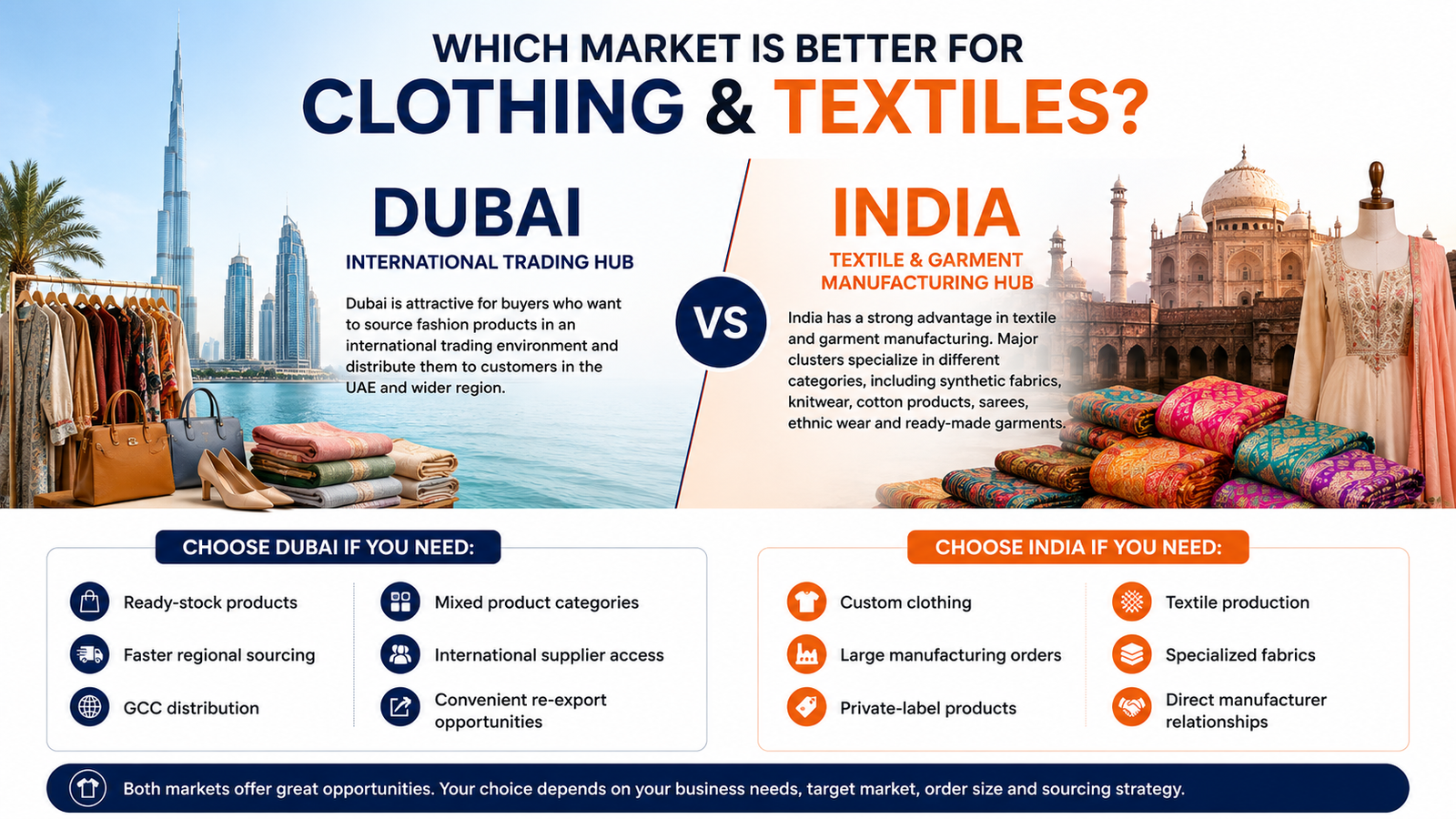
India has a strong advantage in textile and garment manufacturing. Major clusters specialize in different categories, including synthetic fabrics, knitwear, cotton products, sarees, ethnic wear and ready-made garments. (garmentindustry.in)
Dubai is attractive for buyers who want to source fashion products in an international trading environment and distribute them to customers in the UAE and wider region.
Choose India if you need:
- Custom clothing
- Large manufacturing orders
- Private-label products
- Textile production
- Specialized fabrics
- Direct manufacturer relationships
Choose Dubai if you need:
- Ready-stock products
- Faster regional sourcing
- GCC distribution
- Mixed product categories
- International supplier access
- Convenient re-export opportunities
8. Dubai Wholesale Market vs India Wholesale Market for International Buyers
For international buyers, the Dubai Wholesale Market vs India Wholesale Market comparison becomes especially important because the best sourcing location depends on the target market, product category, order quantity, shipping requirements, and business model.
If your target customers are mainly in:
UAE / Saudi Arabia / Qatar / Oman / Kuwait / Bahrain
Dubai can provide a convenient regional sourcing and distribution base.
If your goal is:
Manufacturing → branding → bulk production → international export
India can be a strong option because of its large manufacturing ecosystem.
In some cases, the best strategy is not to choose only one.
A business can source or manufacture products from India and use Dubai as a regional distribution or trading hub, depending on its business structure, costs and applicable customs requirements.
9. Dubai or India – Which Is Better for Your Business?
There is no single answer for every buyer.
Dubai Wholesale Market Is Better If:
You want ready-to-stock products, regional distribution, easier access to GCC markets, or a broad range of imported goods.
India Wholesale Market Is Better If:
You want direct manufacturing, custom products, private labeling, specialized textiles or large production quantities.
Consider Both If:
You are building an international wholesale business and want to combine Indian manufacturing with Dubai-based distribution and regional trading.
For most businesses, the Dubai Wholesale Market vs India Wholesale Market decision should be based on product requirements, order quantity, target customers, shipping costs and long-term sourcing goals.
Final Verdict: Dubai Wholesale Market vs India Wholesale Market
Both Dubai and India offer significant advantages for wholesale buyers.
India is strongest when manufacturing, customization, textiles and large-scale production are the priority.
Dubai is strongest when international trading, ready-stock sourcing, regional distribution and GCC market access are the priority.
The right choice ultimately depends on your product, order quantity, target market, budget, delivery requirements and business model.
Ultimately, the Dubai Wholesale Market vs India Wholesale Market decision should be based on your product requirements, sourcing goals, budget, order size, target customers, and delivery destination.
For smart wholesale sourcing, don’t focus only on the product price. Compare the complete cost from supplier to warehouse, check product quality, negotiate MOQ and evaluate delivery time before making your final decision.
Frequently Asked Questions
Is Dubai cheaper than India for wholesale?
Not necessarily. India can be highly competitive for products manufactured locally, while Dubai can be competitive for imported, ready-stock and regionally distributed products. Total landed cost should be compared before deciding.
Which is better for clothing wholesale, Dubai or India?
India is generally stronger for manufacturing and textile production, while Dubai can be more convenient for ready-stock sourcing and GCC distribution.
Which is better for textile wholesale?
India has major textile production and wholesale clusters, including Surat and other specialized textile centers. (garmentindustry.in) Dubai is useful for international trading and regional distribution.
Can I buy products from India and sell them in Dubai?
Yes, businesses can source products internationally and import them into Dubai subject to the applicable UAE customs, import, product and business requirements.
Is Dubai a good wholesale market for international buyers?
Yes. Dubai’s international trading infrastructure and strong connections with global markets make it an important sourcing and distribution location. markets
What should I check before buying wholesale?
Always check:
- Supplier reliability
- Product quality
- MOQ
- Wholesale price
- Shipping cost
- Customs and duties
- Payment terms
- Delivery time
- Return or replacement policy
- Total landed cost
Conclusion: Dubai Wholesale Market vs India Wholesale Market
Choosing between the Dubai Wholesale Market vs India Wholesale Market depends on your business needs, product category, budget, order quantity, and target market. India is a strong choice for manufacturing, custom clothing, textiles, private-label products, and large-volume orders, while Dubai is an excellent option for ready-stock products, international sourcing, GCC distribution, and convenient regional trading.
Before making a decision, compare the product quality, wholesale prices, MOQ, shipping costs, delivery time, and supplier reliability rather than focusing only on the product price.
Ultimately, the Dubai Wholesale Market vs India Wholesale Market comparison can help retailers, resellers, importers, and fashion businesses choose a sourcing strategy that supports their long-term growth. Whether you need direct manufacturing from India or ready-to-ship wholesale products from Dubai, selecting the right supplier is the key to building a profitable and reliable wholesale business.
Ready to explore wholesale sourcing opportunities? Discover reliable products and suppliers for your business and find the right wholesale solution for your market.