
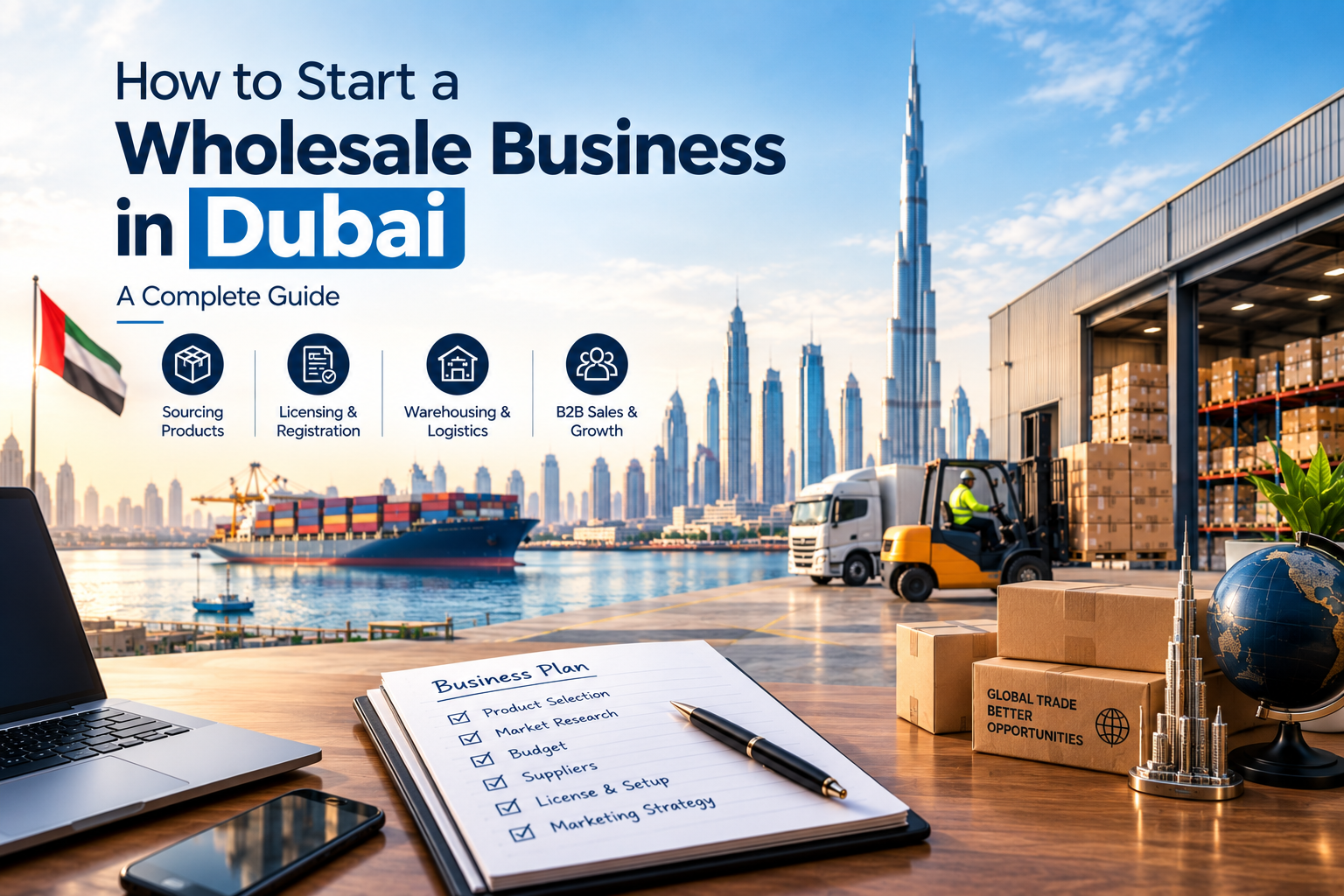
How to Start a Wholesale Business in Dubai: A Complete Guide
Dubai has become one of the leading commercial and trading hubs in the Middle East, making it an attractive destination for entrepreneurs who want to enter the wholesale market. Its strategic location, international logistics network, business infrastructure, and access to regional markets make the city suitable for businesses that import, distribute, and sell products in bulk.
If you are researching How to Start a Wholesale Business in Dubai, the process involves more than simply registering a company. You need to select the right products, understand your target market, choose an appropriate business structure and location, obtain the required trade license, arrange warehousing and logistics, and understand tax and customs requirements.
This guide explains the major steps involved so you can develop a practical plan for starting a wholesale business in Dubai.
What Is a Wholesale Business?
A wholesale business purchases products in large quantities from manufacturers, suppliers, or distributors and sells them in bulk to other businesses rather than directly to individual consumers.
Wholesale customers can include:
- Retail stores
- Supermarkets
- Online retailers
- Hotels and restaurants
- Construction companies
- Offices
- Distributors
- Government and private organizations
- Specialized dealers
For example, a company may import security equipment, electronics, clothing, food products, building materials, or industrial supplies and distribute them to retailers and businesses throughout the UAE.
Before learning How to Start a Wholesale Business in Dubai, it is important to understand which products you want to sell and who your potential customers will be.
Why Start a Wholesale Business in Dubai?
Dubai offers several advantages for companies involved in international trade and distribution.
The city has developed major logistics infrastructure connecting businesses with markets across the Middle East, Africa, Asia, and Europe. This can be particularly useful for wholesalers that depend on importing products and distributing them to customers.
Dubai’s business environment also supports different company structures and locations, including mainland and free-zone options. However, the appropriate choice depends on your activities, customers, ownership structure, warehouse requirements, and intended markets.
A successful wholesale business can also benefit from repeat B2B customers. Instead of relying entirely on individual sales, wholesalers can develop long-term relationships with retailers, contractors, distributors, and corporate buyers.
Step 1: Choose the Right Wholesale Product
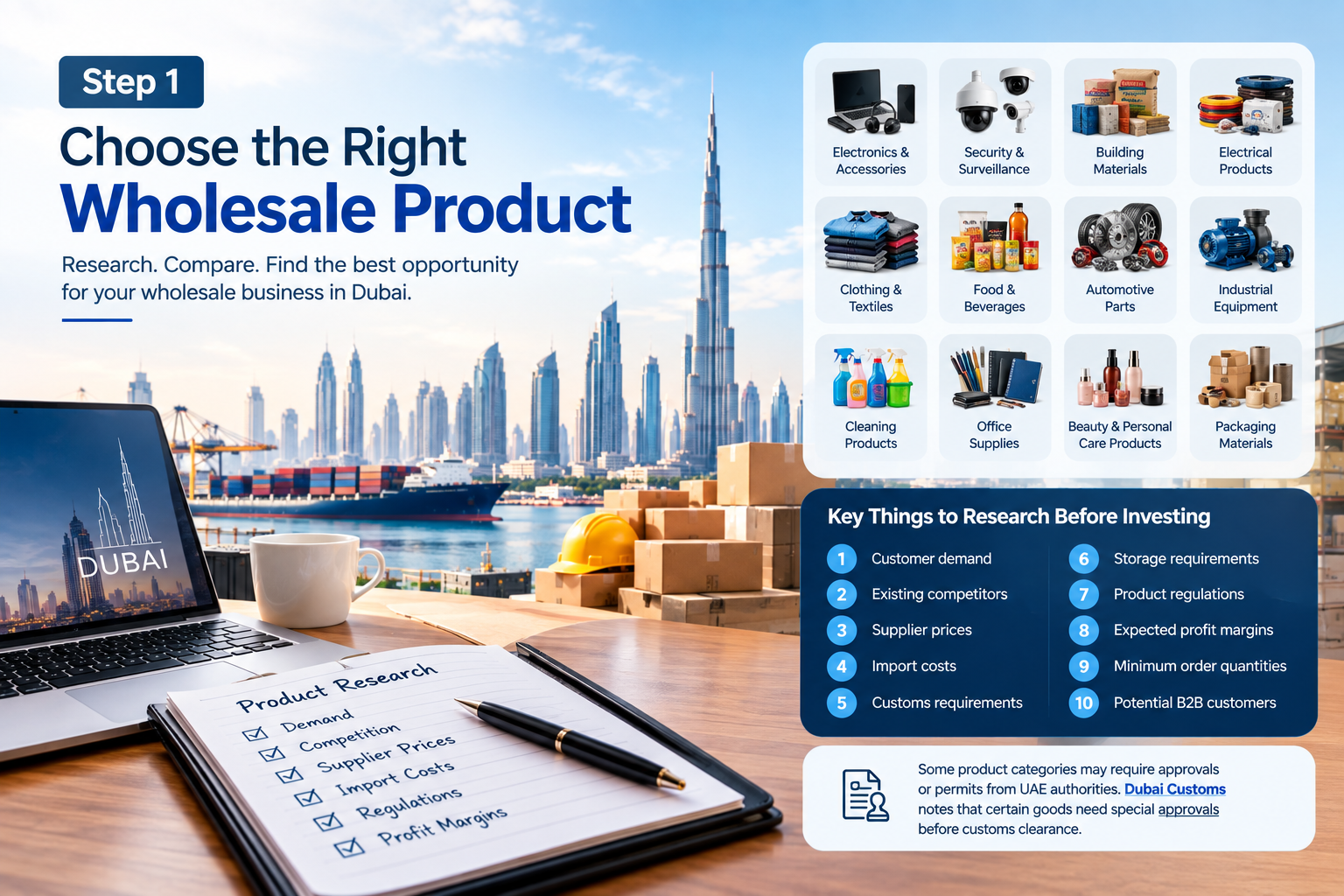
The first step in How to Start a Wholesale Business in Dubai is choosing a product category with realistic demand and manageable competition.
Popular wholesale categories can include:
- Electronics and accessories
- Security and surveillance equipment
- Building materials
- Electrical products
- Clothing and textiles
- Food and beverages
- Automotive parts
- Industrial equipment
- Cleaning products
- Office supplies
- Beauty and personal-care products
- Packaging materials
However, popularity alone should not determine your decision.
Research the following before investing:
- Customer demand
- Existing competitors
- Supplier prices
- Import costs
- Customs requirements
- Storage requirements
- Product regulations
- Expected profit margins
- Minimum order quantities
- Potential B2B customers
Certain product categories may also require approvals or permits from relevant UAE authorities. Dubai Customs notes that some goods require special approvals from the appropriate regulatory authorities before customs clearance.
Step 2: Research Your Dubai Wholesale Market
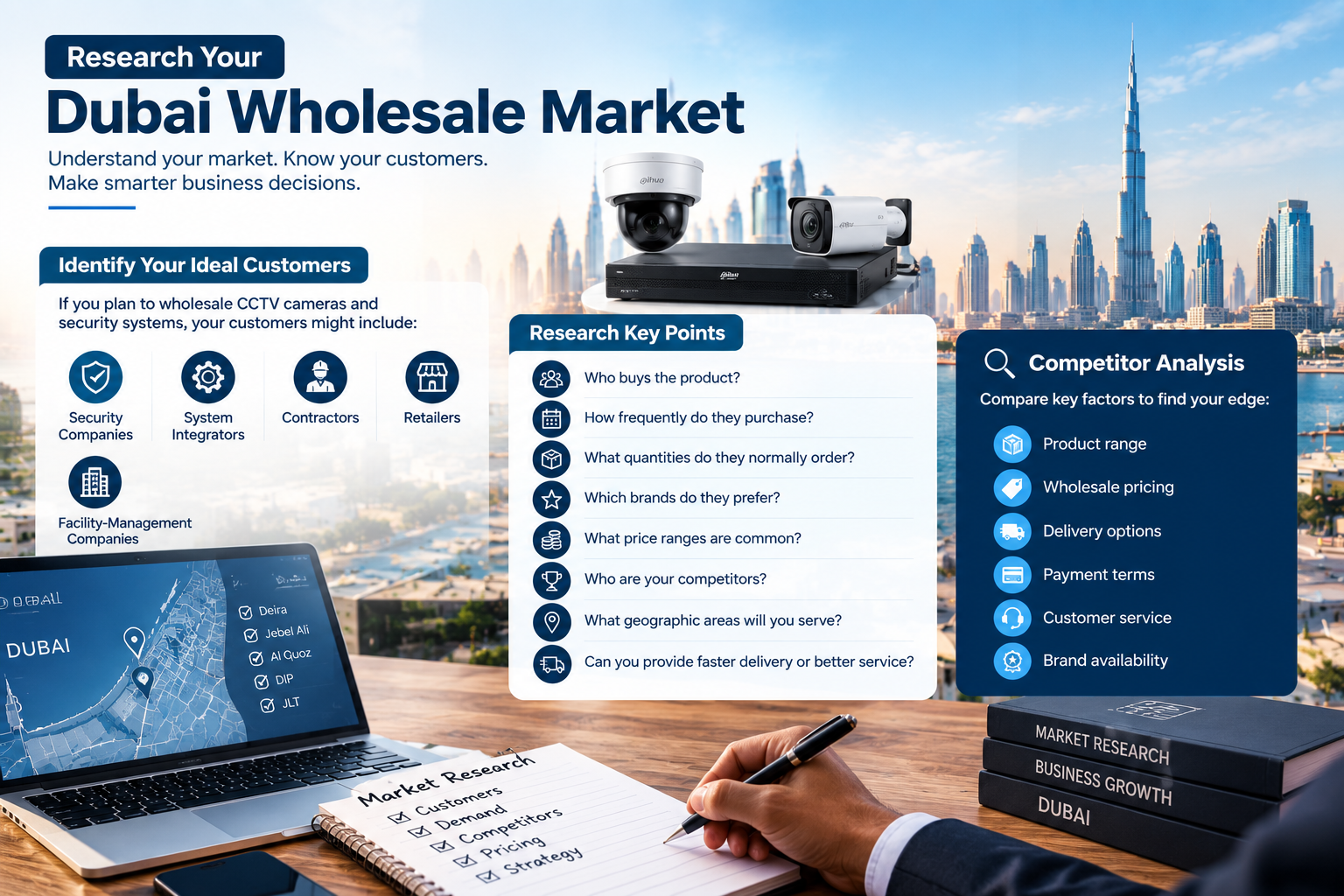
Market research is essential before purchasing inventory.
Start by identifying your ideal customers. For example, if you plan to wholesale CCTV cameras and security systems, your customers might include security companies, system integrators, contractors, retailers, and facility-management companies.
You should research:
- Who buys the product?
- How frequently do they purchase?
- What quantities do they normally order?
- Which brands do they prefer?
- What price ranges are common?
- Who are your competitors?
- What geographic areas will you serve?
- Can you provide faster delivery or better service?
A useful approach is to create a simple competitor analysis comparing product range, wholesale pricing, delivery options, payment terms, customer service, and brand availability.
Step 3: Create a Wholesale Business Plan
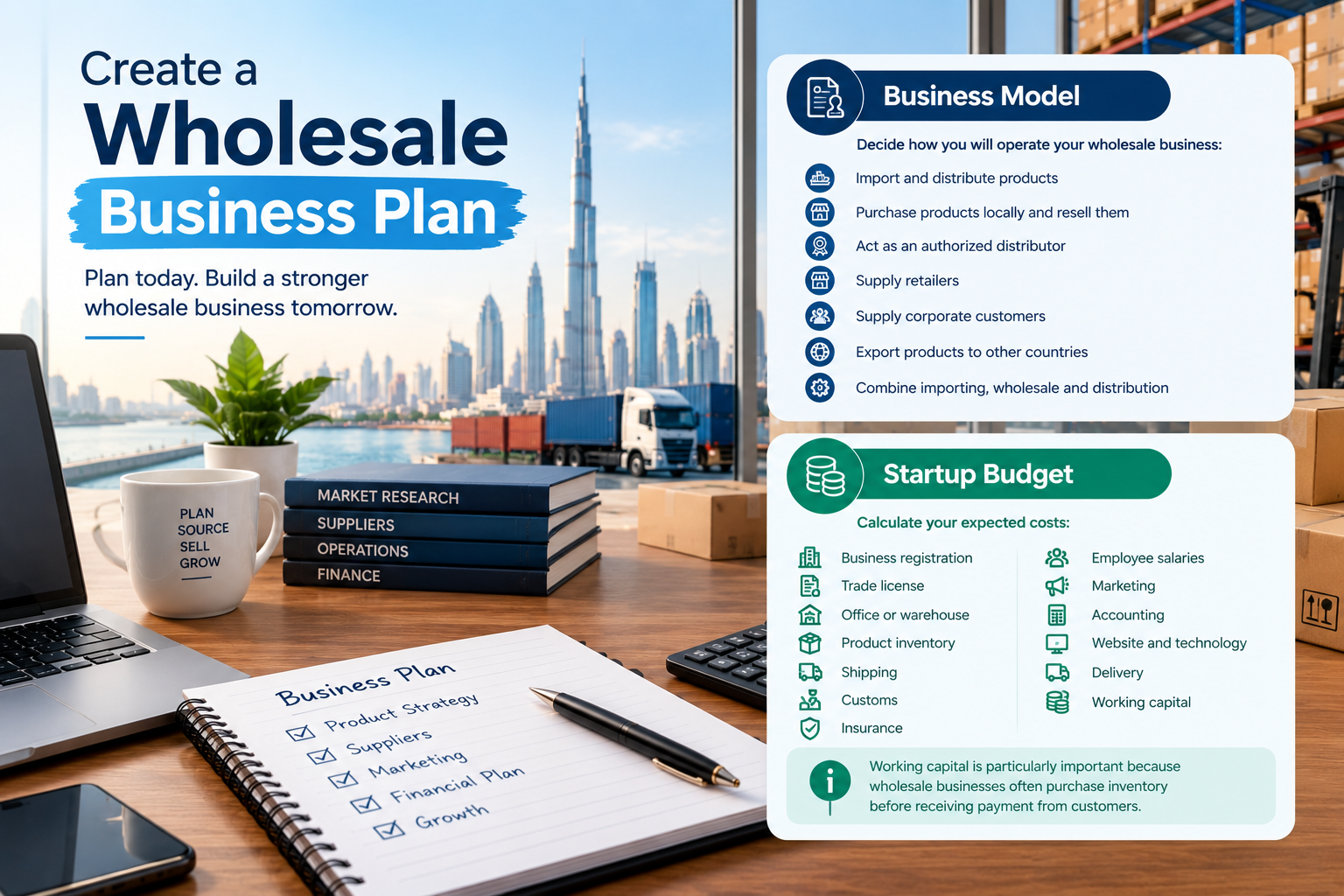
A business plan gives you a clearer picture of the capital and resources required.
Your plan should include:
Business model
Decide whether you will:
- Import and distribute products
- Purchase products locally and resell them
- Act as an authorized distributor
- Supply retailers
- Supply corporate customers
- Export products to other countries
- Combine importing, wholesale, and distribution
Startup budget
Calculate expected costs for:
- Business registration
- Trade license
- Office or warehouse
- Product inventory
- Shipping
- Customs
- Insurance
- Employee salaries
- Marketing
- Accounting
- Website and technology
- Delivery
- Working capital
Working capital is particularly important because wholesale businesses often purchase inventory before receiving payment from customers.
Step 4: Select Mainland or Free Zone
One of the major decisions when learning How to Start a Wholesale Business in Dubai is choosing between a mainland company and a free-zone company.
A mainland setup may be suitable if your business model requires extensive local UAE sales and distribution. Free zones can provide different advantages depending on the location, activity, infrastructure, and ownership requirements.
The right option depends on your exact business activity and how your products will move through the UAE.
For a wholesale company, consider:
- Where your customers are located
- Whether you need a warehouse
- Whether you import products
- Whether you plan to sell within the UAE
- Whether you export to other countries
- Logistics requirements
- Office requirements
- Licensing conditions
Rather than choosing a location solely because its initial setup cost appears lower, compare the total cost and operational requirements of each option.
For official information about setting up and doing business in Dubai, you can consult Invest in Dubai and the UAE government’s business information portal.
Step 5: Obtain the Appropriate Trade License
A wholesale company needs a business license covering the activities it intends to conduct.
The exact licensing requirements depend on the products and business activities.
For example, a company involved in wholesale trading of electronics may require a different activity classification from a company dealing with food products or industrial machinery.
When applying for a license, carefully identify all activities you expect to conduct. Adding relevant activities at the beginning can help avoid unnecessary amendments later.
You should prepare the required corporate and personal documentation according to the licensing authority’s requirements.
Step 6: Find Reliable Suppliers
Suppliers are one of the most important parts of a wholesale business.
You can source products from:
- China
- Turkey
- India
- Europe
- Southeast Asia
- Local UAE manufacturers
- International manufacturers
- Authorized distributors
Before signing a supplier agreement, investigate:
- Product quality
- Certifications
- Wholesale prices
- Minimum order quantities
- Production capacity
- Delivery times
- Payment terms
- Warranty policies
- Return procedures
- Packaging standards
If possible, order samples before placing a large purchase order.
For branded products, also confirm whether the supplier is authorized to distribute the brand. This can help reduce risks related to counterfeit products and unauthorized distribution.
Step 7: Arrange Warehousing and Inventory
A wholesale business generally requires more storage space than a typical retail business.
Your warehouse should be appropriate for the products you are storing.
Consider:
- Warehouse size
- Location
- Loading and unloading access
- Security
- Temperature requirements
- Shelving
- Inventory management
- Fire safety
- Insurance
- Delivery access
Inventory management is especially important because excess inventory can tie up capital, while insufficient inventory can cause lost sales.
Use inventory software or an ERP system to monitor stock levels, purchase orders, sales orders, damaged products, and reorder points.
Step 8: Register With Dubai Customs if You Import or Export
If your wholesale business will import or export products through Dubai, customs registration is an important part of the process.
Dubai Customs states that businesses using Dubai Customs services need to register their business. The registration provides a Customs Business Code used for customs transactions.
The current Dubai Customs business-registration service lists a trade license copy, authorized person’s passport copy, and Emirates ID copy among the required documents.
You can find the official service information through Dubai Customs.
You should also understand:
- Import documentation
- Commercial invoices
- Packing lists
- Certificates of origin
- Customs declarations
- Shipping documents
- Product-specific approvals
- Customs duties
- Freight and clearing charges
For certain products, additional regulatory approvals may be required.
Step 9: Understand VAT Requirements
VAT is another important consideration when planning How to Start a Wholesale Business in Dubai.
The UAE Federal Tax Authority states that VAT registration is mandatory for UAE businesses when the value of taxable supplies and imports exceeds AED 375,000 over the previous 12 months or is expected to exceed that threshold within the next 30 days.
Voluntary VAT registration is available when the relevant threshold of AED 187,500 is exceeded, subject to the applicable rules.
You can check the latest requirements and register through the official UAE Federal Tax Authority website.
A wholesale business should maintain accurate records of:
- Sales invoices
- Purchase invoices
- Import documents
- VAT charged
- VAT paid
- Business expenses
- Customs documentation
Professional accounting support can be useful, particularly as transaction volumes increase.
Step 10: Understand UAE Corporate Tax
UAE businesses should also consider Corporate Tax when planning their financial structure.
According to the Federal Tax Authority, taxable income up to AED 375,000 is subject to a 0% Corporate Tax rate, while taxable income exceeding AED 375,000 is generally subject to 9%, subject to the applicable legislation and rules.
Corporate Tax and VAT are separate obligations. A business may have Corporate Tax obligations even if it is not registered for VAT.
The FTA also states that taxable persons are required to register for Corporate Tax according to the applicable registration timelines.
Because tax treatment can depend on your legal structure, revenue, activities, and other factors, maintain proper accounting records and obtain professional tax advice where necessary.
Step 11: Build a B2B Sales Strategy
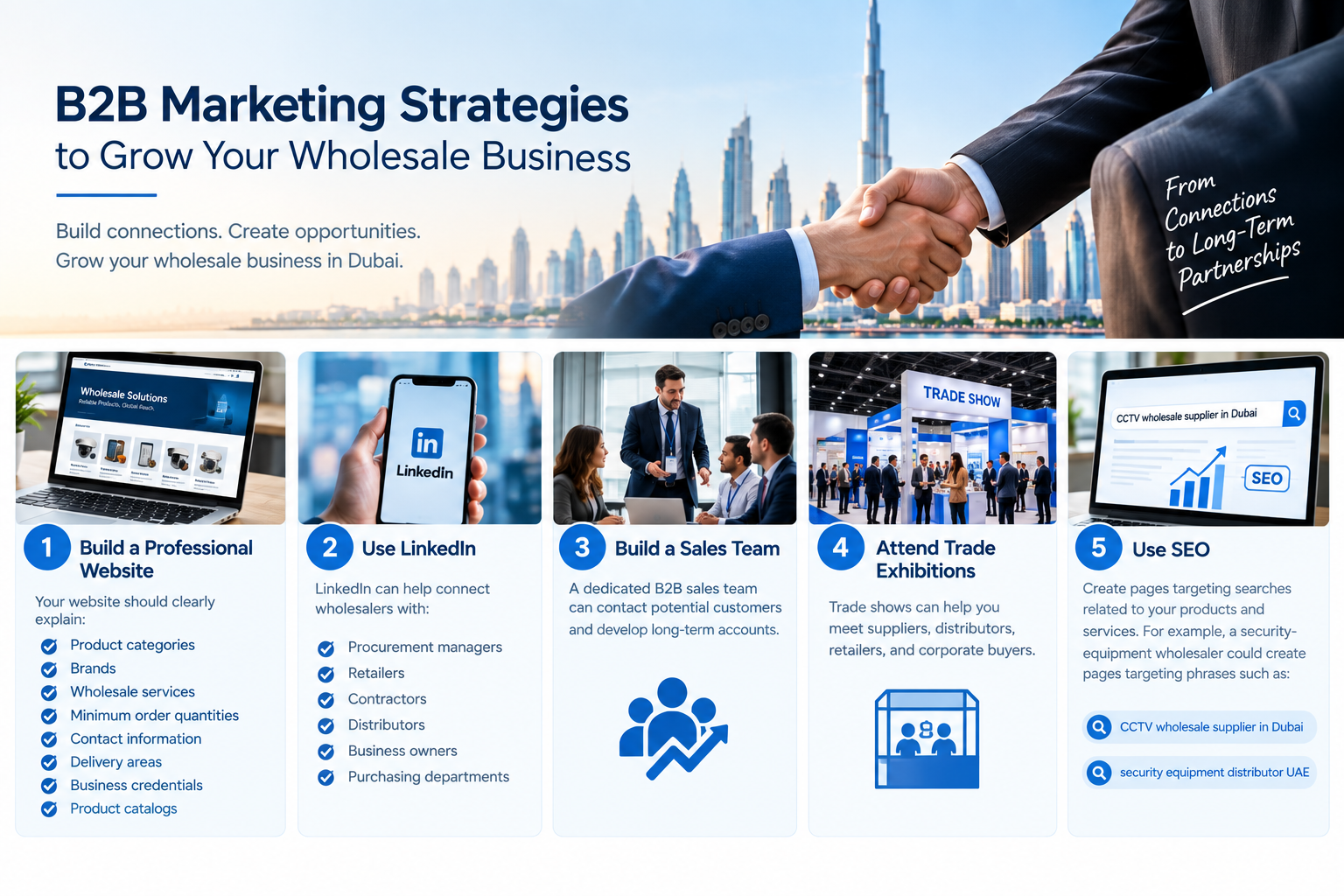
Once your company is legally established, you need customers.
Wholesale businesses should focus heavily on B2B marketing rather than relying only on consumer advertising.
Potential strategies include:
Build a professional website
Your website should clearly explain:
- Product categories
- Brands
- Wholesale services
- Minimum order quantities
- Contact information
- Delivery areas
- Business credentials
- Product catalogs
Use LinkedIn
LinkedIn can help connect wholesalers with:
- Procurement managers
- Retailers
- Contractors
- Distributors
- Business owners
- Purchasing departments
Build a sales team
A dedicated B2B sales team can contact potential customers and develop long-term accounts.
Attend trade exhibitions
Trade shows can help you meet suppliers, distributors, retailers, and corporate buyers.
Use SEO
Create pages targeting searches related to your products and services. For example, a security-equipment wholesaler could create pages targeting phrases such as “CCTV wholesale supplier in Dubai” or “security equipment distributor UAE.”
Step 12: Set Competitive Wholesale Prices
Pricing is critical.
Your selling price should consider:
Product Cost + Shipping + Customs + Warehouse + Staff + Marketing + Other Expenses + Desired Margin = Wholesale Price
However, avoid simply adding a fixed percentage to your supplier’s price.
You should also consider competitor pricing and customer purchasing volume.
For large customers, you may offer volume-based pricing such as:
- 1–20 units: Standard price
- 21–100 units: Discounted price
- 101–500 units: Better wholesale price
- 500+ units: Negotiated price
This structure can encourage larger orders while protecting your margins.
Step 13: Build Strong Customer Relationships
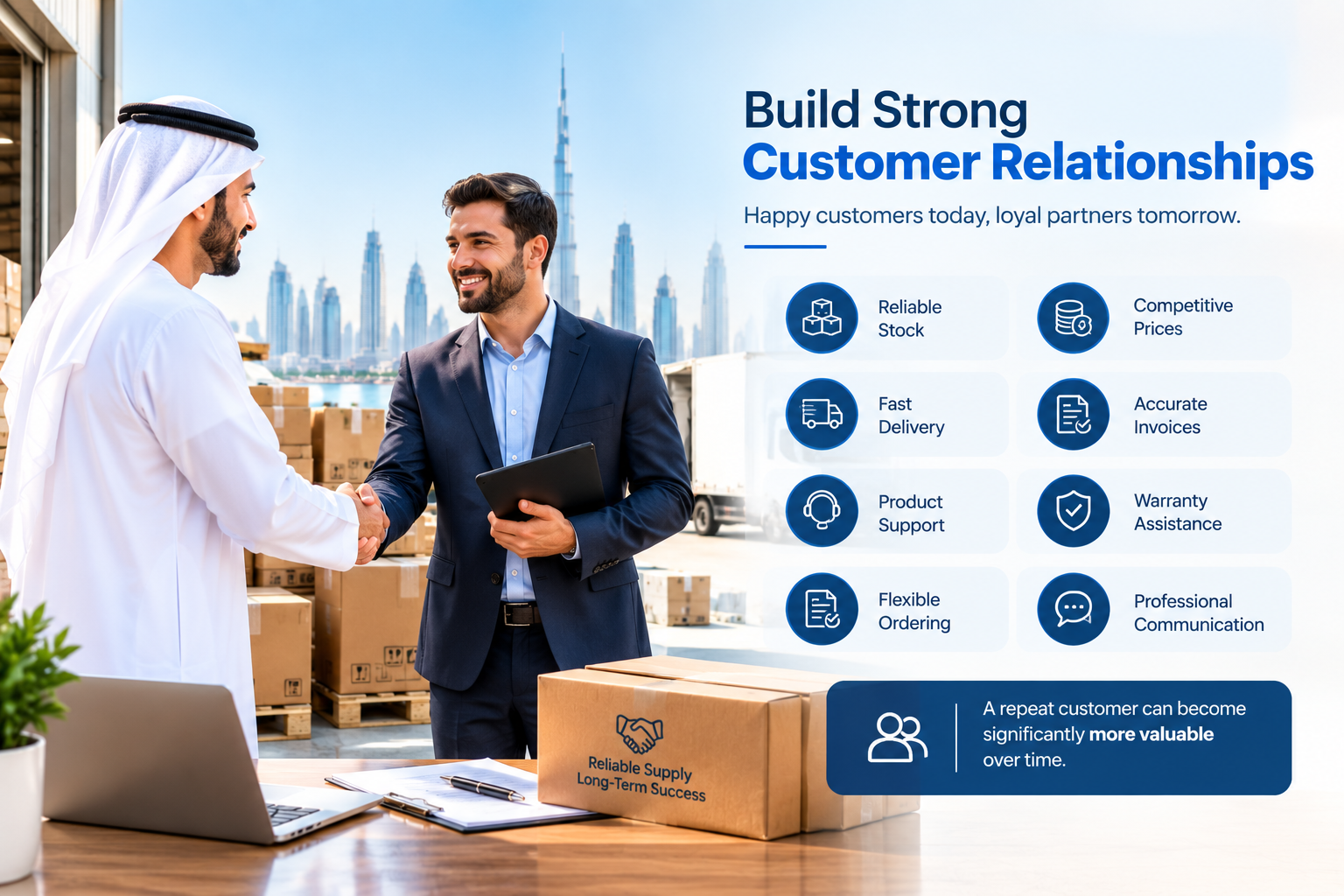
Long-term relationships are especially important in wholesale.
Retailers and businesses may repeatedly purchase the same products if you provide:
- Reliable stock
- Competitive prices
- Fast delivery
- Accurate invoices
- Product support
- Warranty assistance
- Flexible ordering
- Professional communication
Do not focus only on the first sale. A repeat customer can become significantly more valuable over time.
Common Mistakes to Avoid
When learning How to Start a Wholesale Business in Dubai, entrepreneurs should avoid several common mistakes.
Buying too much inventory
Large inventory can create cash-flow problems if products sell slowly.
Choosing products without research
A product may be popular internationally but have limited demand in your target segment.
Ignoring import requirements
Certain products may require additional approvals, certifications, or documentation.
Competing only on price
The cheapest supplier does not always build the strongest business. Service, reliability, availability, and product quality can also influence B2B buyers.
Poor cash-flow management
Wholesale businesses can have significant money tied up in inventory and customer credit.
Not keeping accurate records
Proper accounting and documentation are essential for tax, customs, financial management, and business planning.
How Much Capital Do You Need?
The investment required depends heavily on the product category and business model.
A small trading operation with limited inventory may require substantially less capital than a large importer operating a warehouse and maintaining significant stock.
Your initial budget should account for:
- Licensing
- Office
- Warehouse
- Inventory
- Shipping
- Customs
- Employees
- Technology
- Marketing
- Insurance
- Working capital
Instead of asking only, “How much does it cost to start a wholesale business?” calculate how much money you need to operate comfortably for the first several months.
Final Checklist for Starting a Wholesale Business in Dubai
Before launching, make sure you have considered the following:
- Choose a profitable product category
- Research the Dubai market
- Identify target B2B customers
- Prepare a business plan
- Select mainland or free zone
- Choose the correct business activities
- Obtain the appropriate trade license
- Find reliable suppliers
- Arrange warehouse facilities
- Set up inventory management
- Register with Dubai Customs if required
- Understand VAT requirements
- Register for Corporate Tax where required
- Arrange accounting
- Build a professional website
- Develop a B2B sales strategy
- Establish competitive pricing
- Plan logistics and delivery
- Build long-term customer relationships
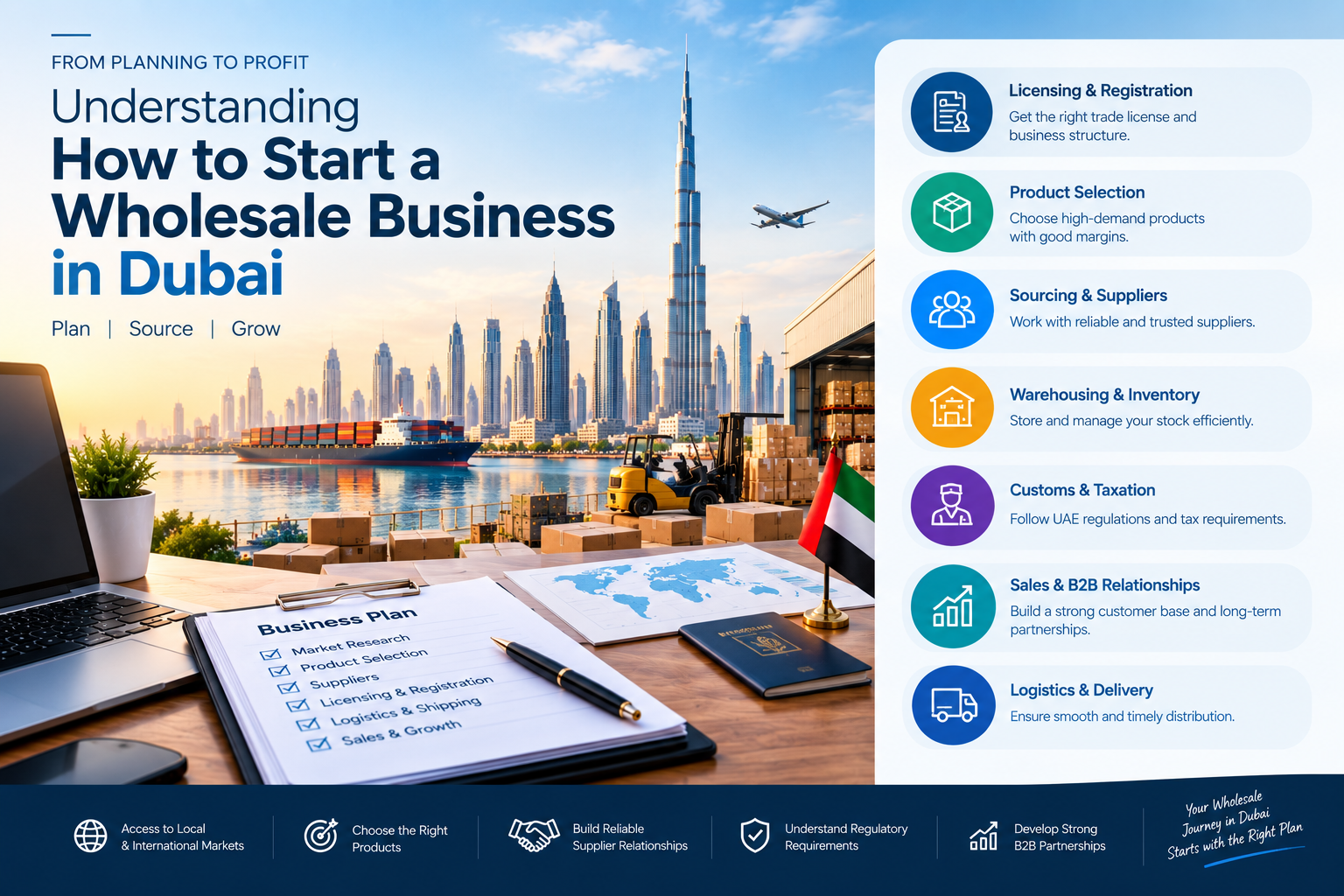
Understanding How to Start a Wholesale Business in Dubai requires careful planning across licensing, product selection, sourcing, warehousing, customs, taxation, sales, and logistics.
Dubai can provide access to local and international markets, but success depends on selecting the right products, controlling costs, maintaining reliable suppliers, understanding regulatory requirements, and developing strong B2B relationships.
Start with detailed market research rather than purchasing large quantities immediately. Once you understand your customers and expected margins, choose the appropriate business structure, obtain the required licenses, establish your supply chain, and build a professional sales operation.
For official and current regulatory information, always verify requirements directly with the relevant Dubai and UAE authorities because licensing, tax, customs, and regulatory rules can change.