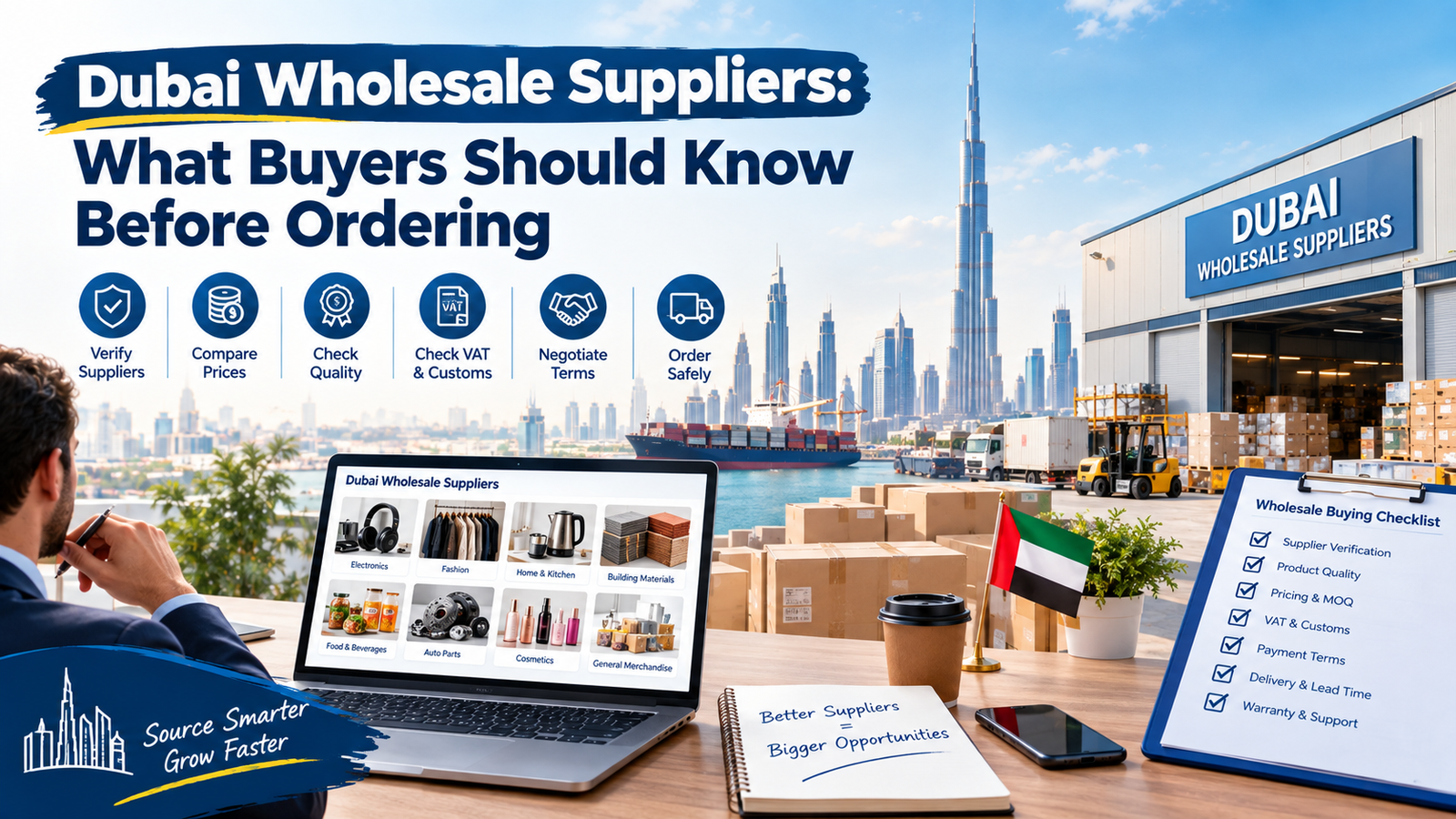
Dubai Wholesale Suppliers: What Buyers Should Know Before Ordering
Finding reliable Dubai Wholesale Suppliers can be a valuable opportunity for retailers, online sellers, distributors, restaurants, contractors, and other businesses looking to source products in bulk. Dubai has developed into a major commercial and logistics hub, giving buyers access to a wide range of products, manufacturers, distributors, importers, and trading companies.
However, choosing a supplier should involve more than comparing product prices. A low wholesale price does not always mean a lower overall purchasing cost. Product quality, minimum order quantities, delivery charges, payment terms, documentation, customs requirements, VAT, warranty support, and supplier reliability can all affect the final value of an order.
Whether you are buying electronics, clothing, building materials, home products, food items, packaging, cosmetics, auto parts, or general merchandise, it is important to understand how wholesale purchasing works before placing a large order.
This guide explains what buyers should look for when dealing with Dubai Wholesale Suppliers, how to compare suppliers, what questions to ask before ordering, and how to reduce common purchasing risks.
Why Buy From Dubai Wholesale Suppliers?
Dubai offers several advantages for businesses that need products in commercial quantities.
One of the biggest advantages is access to an established trading and logistics ecosystem. Dubai connects businesses with suppliers and markets across the Middle East, Asia, Africa, and Europe.
For buyers, this can make Dubai an attractive sourcing location for both local distribution and international trade.
Depending on the product category, Dubai Wholesale Suppliers may provide:
- Bulk purchasing options
- Local stock availability
- Import and distribution services
- Private-label opportunities
- Product customization
- Regional delivery
- Export services
- Warehousing
- Product samples
- Business-to-business pricing
Another advantage is the variety of suppliers available. Buyers can find companies specializing in particular product categories rather than relying on a single general distributor.
However, supplier availability does not automatically mean supplier reliability. Businesses should carry out proper checks before committing to a significant purchase.
What Products Can You Buy Wholesale in Dubai?
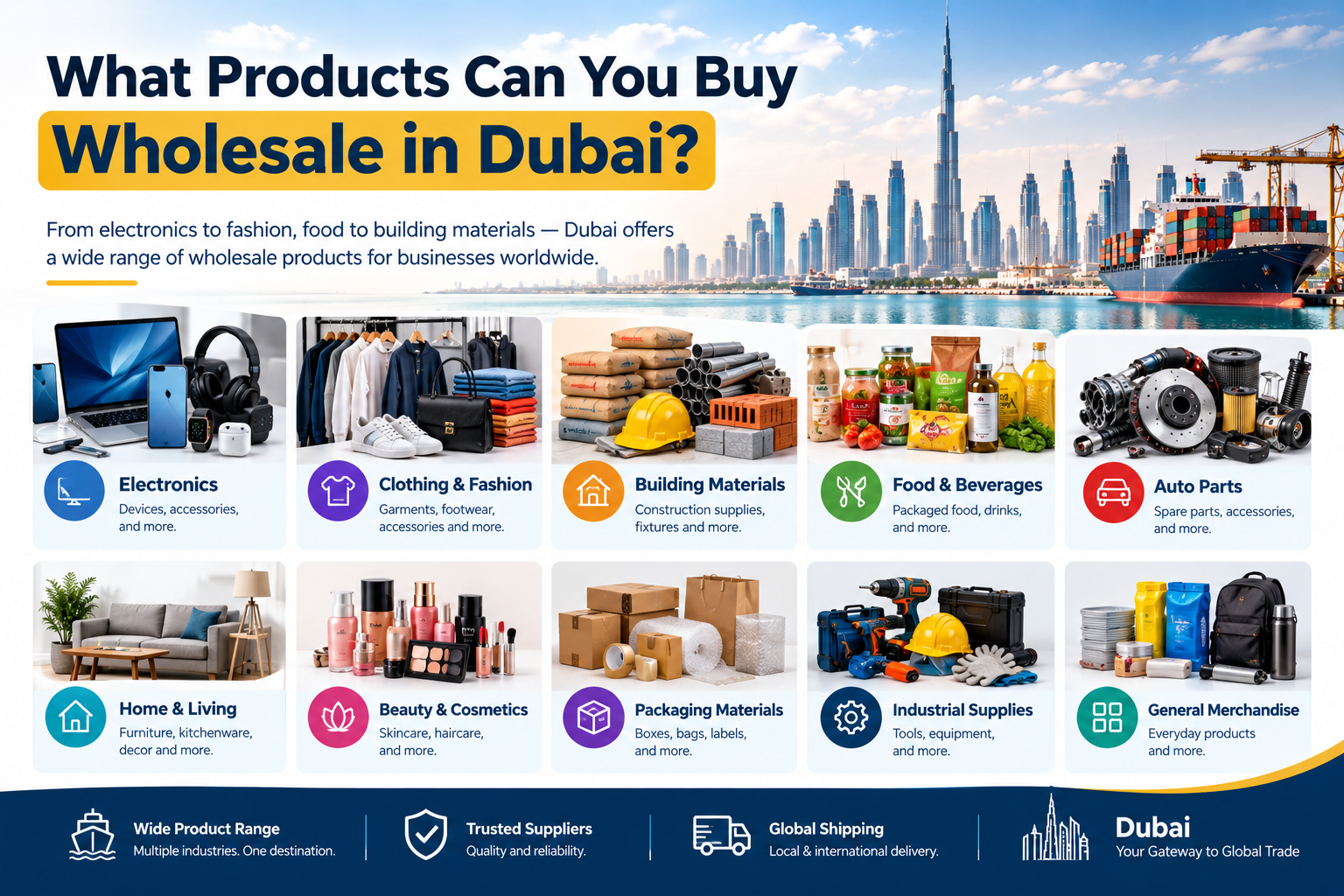
Dubai’s wholesale market covers a wide range of industries.
Depending on your business requirements, you may find suppliers dealing in:
Electronics
Wholesale electronics can include accessories, consumer devices, networking equipment, mobile accessories, security products, and other technology-related products.
When buying electronics, check product specifications, warranty terms, certification requirements, and whether products are genuine, refurbished, or compatible alternatives.
Clothing and Fashion
Dubai has a large trading ecosystem for garments, footwear, accessories, uniforms, and fashion products.
Retailers should check fabric quality, sizing, packaging, branding, and minimum order quantities before ordering large volumes.
Building Materials
Construction businesses can source many types of building and finishing products through local distributors and trading companies.
For technical products, buyers should confirm specifications, standards, manufacturer documentation, and delivery schedules before placing an order.
Food and Beverages
Food-related wholesale purchasing requires additional attention to packaging, expiration dates, storage requirements, labeling, and applicable regulatory requirements.
Auto Parts
Auto parts buyers should verify part numbers, compatibility, manufacturer details, warranty conditions, and whether products are original equipment, aftermarket, or used.
Home and General Merchandise
Household products, kitchenware, furniture accessories, cleaning products, packaging materials, and general merchandise are also commonly traded through wholesale channels.
The right supplier will depend on your product category, target market, order volume, and delivery requirements.
How to Choose Dubai Wholesale Suppliers
Selecting a supplier should be treated as a business decision rather than simply a price comparison.
Before placing an order, create a shortlist of several Dubai Wholesale Suppliers and compare them using the same criteria.
1. Check the Business Information
Start by verifying the company’s basic business information.
Ask for:
- Company name
- Trade license details
- Business address
- Contact information
- Product catalog
- VAT information where applicable
- Bank account details
- Website or business profile
You should be particularly careful when a supplier is unwilling to provide basic company information.
For businesses involved in importing or exporting through Dubai, official customs procedures are also important. Dubai Customs states that businesses using Dubai Customs services need to register, and its current business-registration service provides a customs code after registration.
Dubai Customs official services
2. Ask for a Detailed Quotation
Never compare suppliers based only on a single product price.
Ask each supplier for an itemized quotation showing:
- Product unit price
- Minimum order quantity
- Packaging cost
- Delivery cost
- VAT
- Payment terms
- Lead time
- Warranty
- Additional charges
This allows you to calculate the real landed cost of your order.
For example, Supplier A may offer a lower unit price but charge higher delivery and packaging fees. Supplier B may have a slightly higher unit price but include delivery and better payment terms.
The second option could therefore produce a different overall purchasing cost.
Understand Minimum Order Quantities
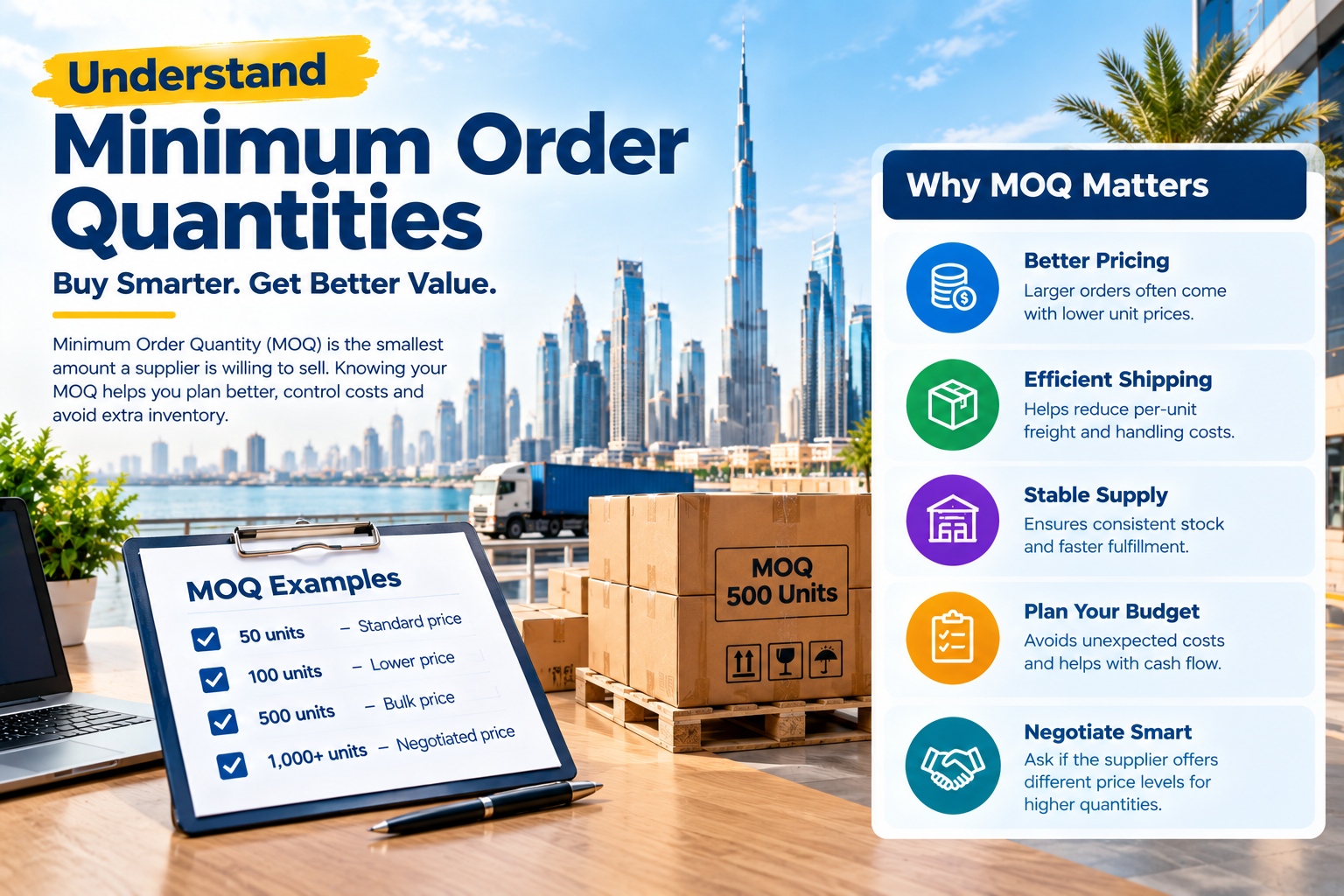
Minimum Order Quantity, commonly called MOQ, is an important consideration when working with Dubai Wholesale Suppliers.
Some suppliers may accept small wholesale orders, while others may require buyers to purchase cartons, cases, pallets, or larger quantities.
Before negotiating a price, ask:
What is your minimum order quantity?
Then ask whether the supplier offers different pricing levels.
For example:
- 50 units: standard wholesale price
- 100 units: lower price
- 500 units: bulk price
- 1,000+ units: negotiated price
This can help you determine whether ordering more actually provides enough savings to justify the additional inventory.
Do not purchase excessive stock simply to receive a lower unit price. Unsold inventory can tie up working capital and create storage costs.
Request Product Samples Before Bulk Ordering
One of the safest ways to evaluate Dubai Wholesale Suppliers is to request samples before placing a large order.
A sample allows you to check:
- Product quality
- Materials
- Packaging
- Size
- Color
- Functionality
- Branding
- Labels
- Manufacturing quality
For technical products, you can also test performance before committing to a larger quantity.
If the supplier offers a sample, ask whether the sample is representative of the actual bulk product.
A common purchasing mistake is approving a sample and then assuming the final shipment will automatically match it. Your purchase order should clearly specify the agreed product model, specifications, packaging, quantity, and quality requirements.
Compare Quality, Not Just Price
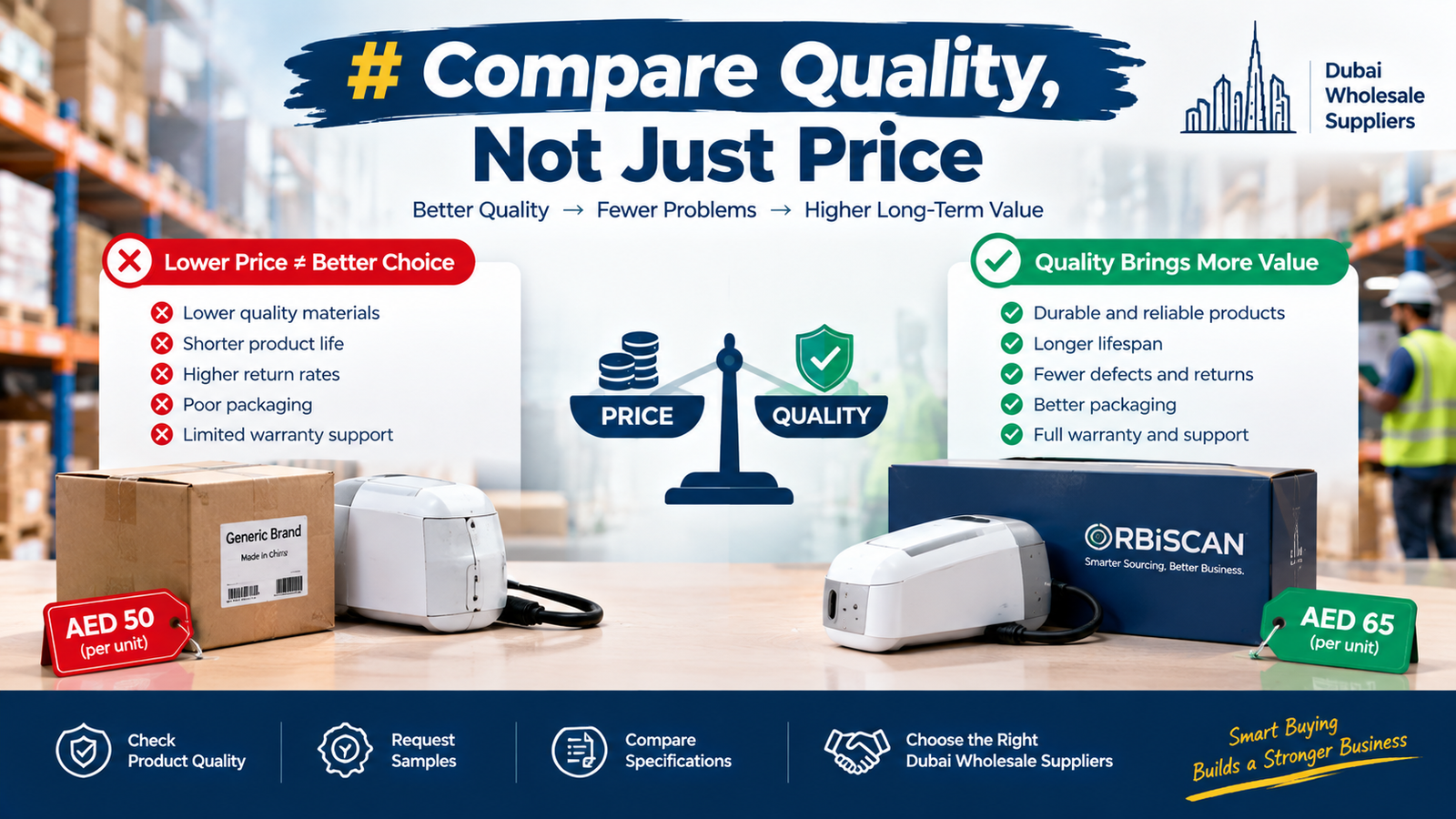
Price is important, but it should not be the only factor when comparing Dubai Wholesale Suppliers.
A cheaper product may have:
- Lower-quality materials
- Shorter product life
- Higher return rates
- Poor packaging
- Limited warranty support
- Inconsistent specifications
These problems can cost more than the original savings.
A better approach is to calculate the expected total cost of ownership.
For example, if Product A costs AED 20 and Product B costs AED 24, Product B may still be commercially preferable if it has better durability, fewer defects, stronger packaging, and a better warranty.
The correct choice depends on your customers and business model.
Understand VAT and Business Costs
VAT should be considered when calculating the final purchase cost.
The UAE Federal Tax Authority states that the standard VAT rate is 5%, although specific supplies can be zero-rated or exempt depending on the applicable rules.
UAE Federal Tax Authority – VAT information
When requesting quotations, ask the supplier whether the quoted price includes VAT.
For registered businesses, VAT treatment can affect accounting and cash flow. The FTA also provides an official VAT registration service through the EmaraTax platform.
For this reason, buyers should not assume that a quoted wholesale price is the final amount payable.
Always confirm the invoice total before making payment.
Check Import and Customs Requirements
If you are buying products for export or importing goods through Dubai, customs requirements should be considered before ordering.
Dubai Customs provides services covering business registration, customs declarations, import, export, transit, and other trade processes.
Dubai Customs – Business Registration
Some products may also require approvals from relevant authorities before they can be released. Dubai Customs notes that certain restricted goods require approval from the relevant authorities as part of the clearance process.
Therefore, before placing an international order, determine:
- HS code
- Customs requirements
- Import restrictions
- Required certificates
- Product approvals
- Shipping documentation
- Country-of-origin documentation
- Applicable duties and taxes
For specialized products, it may be useful to work with an experienced customs broker or freight forwarder.
Check Payment Terms Carefully
Payment terms can significantly affect your business risk.
Different Dubai Wholesale Suppliers may offer different arrangements, such as:
- 100% payment before production
- Deposit plus balance
- Payment on delivery
- Bank transfer
- Credit terms for approved customers
- Letter of credit for larger transactions
Do not automatically choose the supplier offering the longest credit period.
Instead, consider the supplier’s overall commercial terms and your level of trust in the business relationship.
For a new supplier, smaller initial orders can help establish reliability before you commit significant funds.
Always verify bank details through an independent communication channel before making a large transfer, particularly if the supplier suddenly changes payment instructions.
Review Delivery and Lead Times
Delivery time matters because delays can affect your customers, projects, and cash flow.
Ask suppliers:
How long will the order take to prepare?
Also clarify whether the quoted lead time starts from:
- Purchase order confirmation
- Payment receipt
- Sample approval
- Production start
- Shipping booking
For local Dubai deliveries, ask whether transportation is included.
For international shipments, determine whether the quotation is based on EXW, FOB, CIF, DDP, or another commercial arrangement.
If you are unfamiliar with Incoterms, ask the supplier or logistics provider to explain exactly which costs and responsibilities are included.
Evaluate Supplier Communication
Good communication is often an overlooked part of supplier selection.
A reliable supplier should be able to answer basic questions clearly.
Pay attention to:
- Response time
- Product knowledge
- Quotation accuracy
- Documentation
- Willingness to provide samples
- Transparency about stock
- Ability to explain delivery schedules
Poor communication before an order can become an even bigger problem after payment.
You should also identify a specific contact person or account manager for future orders.
Ask About Warranty and Returns
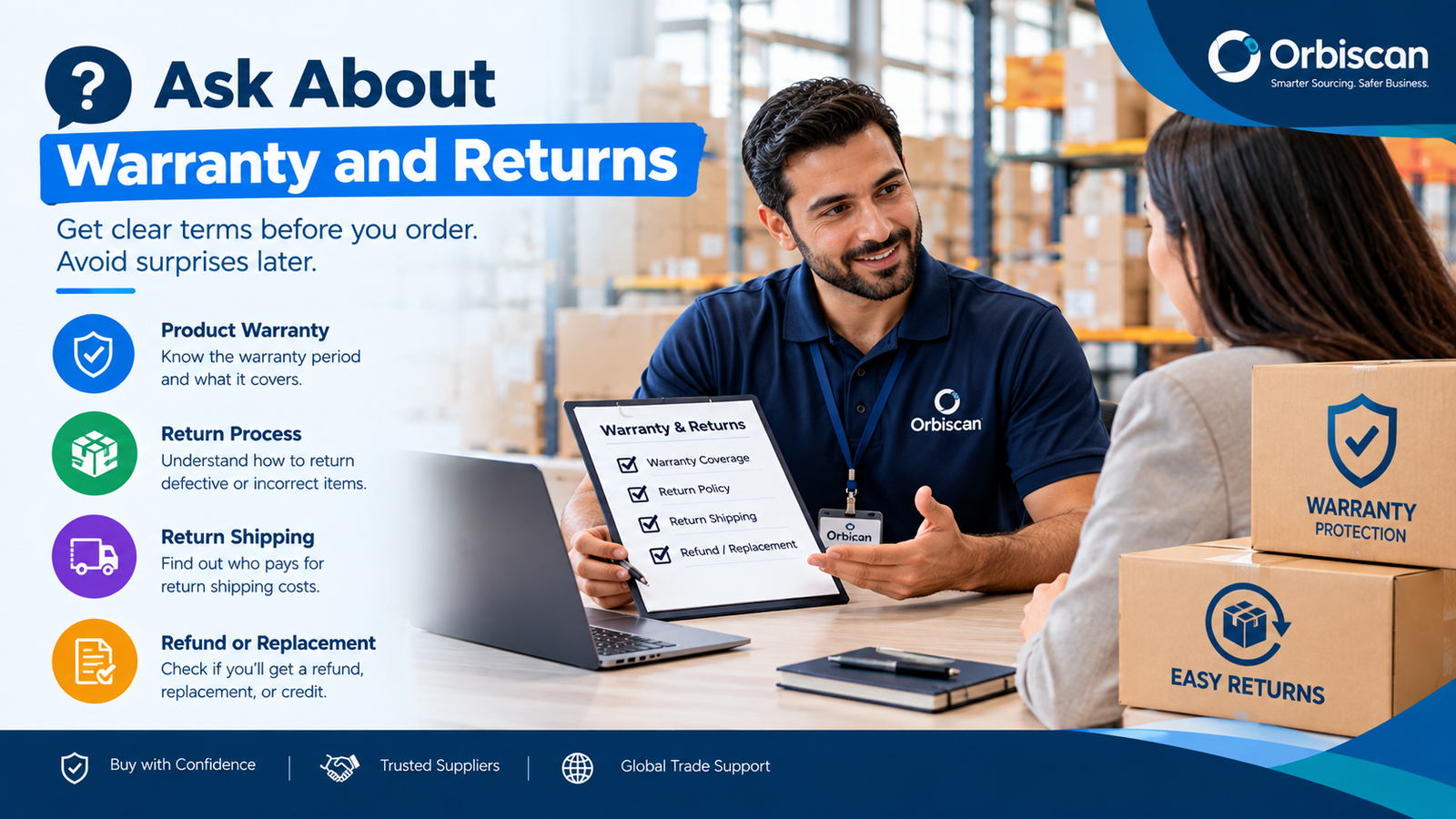
Before ordering from Dubai Wholesale Suppliers, confirm what happens when products arrive damaged, defective, or different from the agreed specification.
Ask:
- Is there a product warranty?
- How long is the warranty period?
- Who pays return shipping?
- What happens to defective products?
- Are replacement units available?
- Is there a credit or refund process?
- What evidence is required for a claim?
For high-value products, warranty terms should ideally be included in the quotation or purchase agreement.
Check Supplier Reputation
Online research can help you identify potential risks before placing an order.
Look for:
- Established business presence
- Customer reviews
- Industry references
- Business associations
- Trade-show participation
- Professional website
- Product documentation
- Consistent company information
Dubai Chambers provides business groups and councils across different industries, which can also be useful for understanding the wider business ecosystem. Its listings include groups covering areas such as building materials, automotive, groceries, and other sectors.
Dubai Chambers – Business Groups & Councils
However, an online presence alone should not be treated as proof of supplier quality. Combine online research with documentation, samples, references, and commercial checks.
Red Flags to Watch For
There are several warning signs buyers should take seriously when evaluating Dubai Wholesale Suppliers.
Be cautious if a supplier:
- Refuses to provide company information
- Provides inconsistent business details
- Demands urgent payment without documentation
- Changes bank details unexpectedly
- Refuses to provide product specifications
- Avoids written quotations
- Offers prices dramatically below the normal market range
- Cannot explain warranty terms
- Pressures you into a very large first order
- Makes unrealistic delivery promises
One warning sign does not necessarily prove that a supplier is unreliable. However, multiple inconsistencies should encourage you to perform additional verification before proceeding.
How to Negotiate With Dubai Wholesale Suppliers
Wholesale negotiation works best when you provide clear information.
Instead of simply asking:
“What is your best price?”
provide:
- Product name
- Quantity
- Required specifications
- Delivery destination
- Expected order frequency
- Packaging requirements
- Payment preference
Then ask the supplier to provide their best commercial quotation.
You can also negotiate based on volume.
For example, ask:
“What price can you offer for 100, 500, and 1,000 units?”
This gives you a better understanding of the supplier’s pricing structure.
You can also negotiate non-price benefits, such as:
- Free samples
- Better packaging
- Reduced delivery fees
- Extended payment terms
- Replacement of defective products
- Faster delivery
- Product customization
Sometimes these benefits can be more valuable than a small reduction in unit price.
Build a Long-Term Supplier Relationship
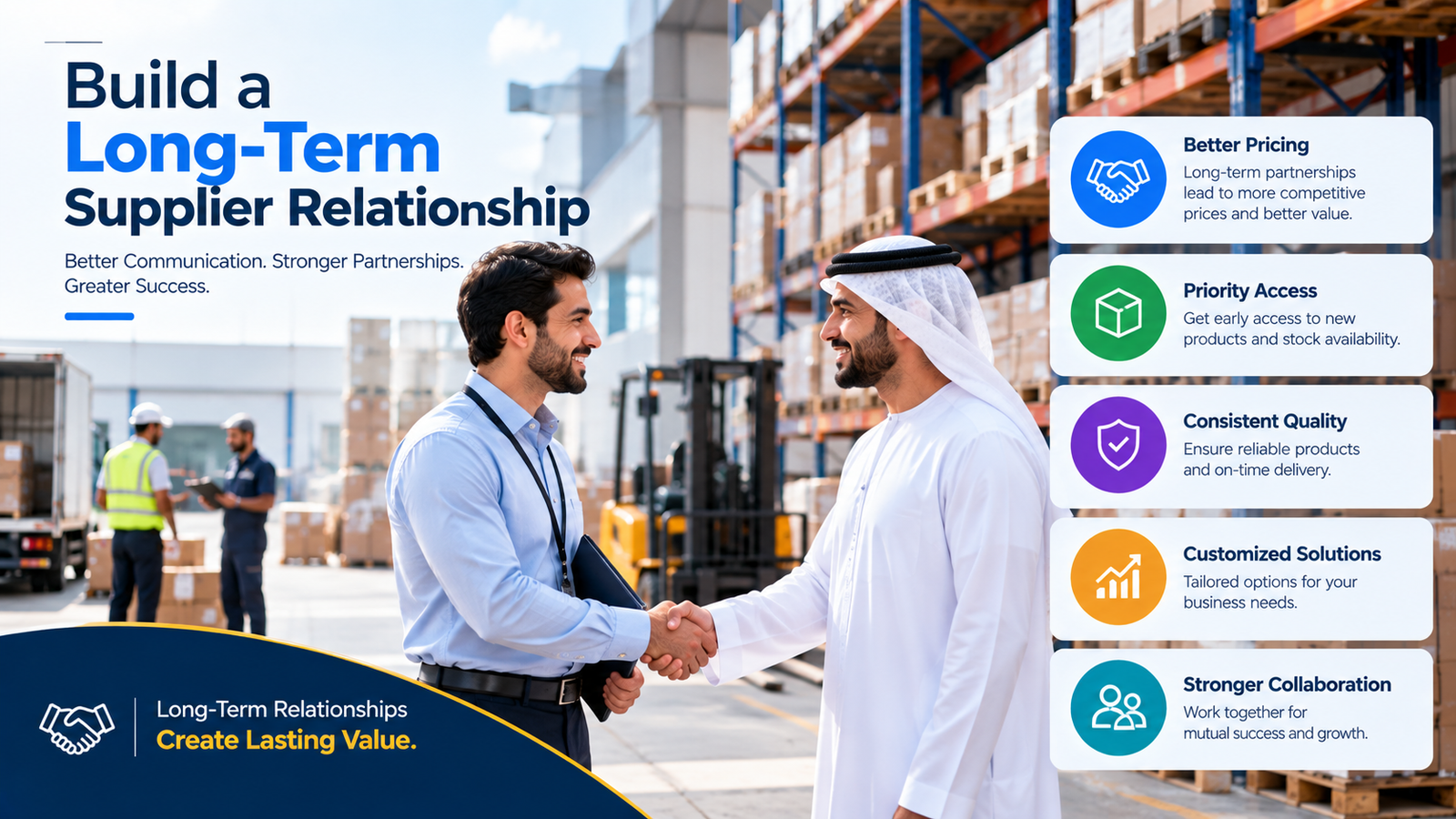
Once you identify reliable Dubai Wholesale Suppliers, building a long-term relationship can make future purchasing easier.
Regular buyers may be able to negotiate improved pricing, priority stock allocation, better communication, or more flexible commercial arrangements.
However, avoid becoming completely dependent on one supplier.
Maintaining alternative suppliers can protect your business if:
- Stock becomes unavailable
- Prices increase
- Delivery is delayed
- A supplier changes its product range
- Business operations are interrupted
A strong sourcing strategy normally combines reliable relationships with sensible supplier diversification.
Dubai Wholesale Suppliers Checklist
Before placing your first bulk order, use this checklist:
Business Verification
- Confirm company name
- Check trade license information
- Confirm business address
- Verify contact details
- Request VAT information where applicable
Product Verification
- Request product specifications
- Order samples
- Confirm packaging
- Confirm quantity
- Check product certifications where relevant
Commercial Terms
- Confirm unit price
- Confirm MOQ
- Check VAT
- Confirm delivery charges
- Agree payment terms
- Confirm warranty conditions
Logistics
- Confirm stock availability
- Confirm lead time
- Determine shipping method
- Check customs requirements
- Confirm required documentation
Final Order
- Use a written quotation
- Review the purchase order
- Confirm bank details
- Keep invoices and documentation
- Record agreed specifications
This simple process can reduce misunderstandings and make wholesale purchasing more predictable.
Working with Dubai Wholesale Suppliers can give businesses access to a broad commercial ecosystem and a wide variety of products. However, successful wholesale purchasing depends on much more than finding the lowest price.
Buyers should evaluate supplier credibility, product quality, minimum order quantities, VAT, delivery costs, payment terms, customs requirements, warranty policies, and after-sales support before committing to a large order.
A small amount of research before ordering can help prevent expensive problems later.
If you are sourcing for a retail store, e-commerce business, construction company, restaurant, distribution operation, or another commercial business, start by creating a shortlist of potential suppliers. Request comparable quotations, obtain samples where practical, verify documentation, and calculate your complete purchasing cost.
For businesses involved in importing or exporting through Dubai, use official government resources for the latest requirements. Dubai Customs provides information and services for business registration and customs procedures, while the UAE Federal Tax Authority provides current VAT guidance and registration services.
The goal should not simply be to find a cheap supplier. The goal is to find a supplier that can consistently provide the right product, at the right quality, at a commercially viable price, with dependable delivery and clear terms.
That approach can help turn a one-time wholesale purchase into a sustainable supply relationship.