
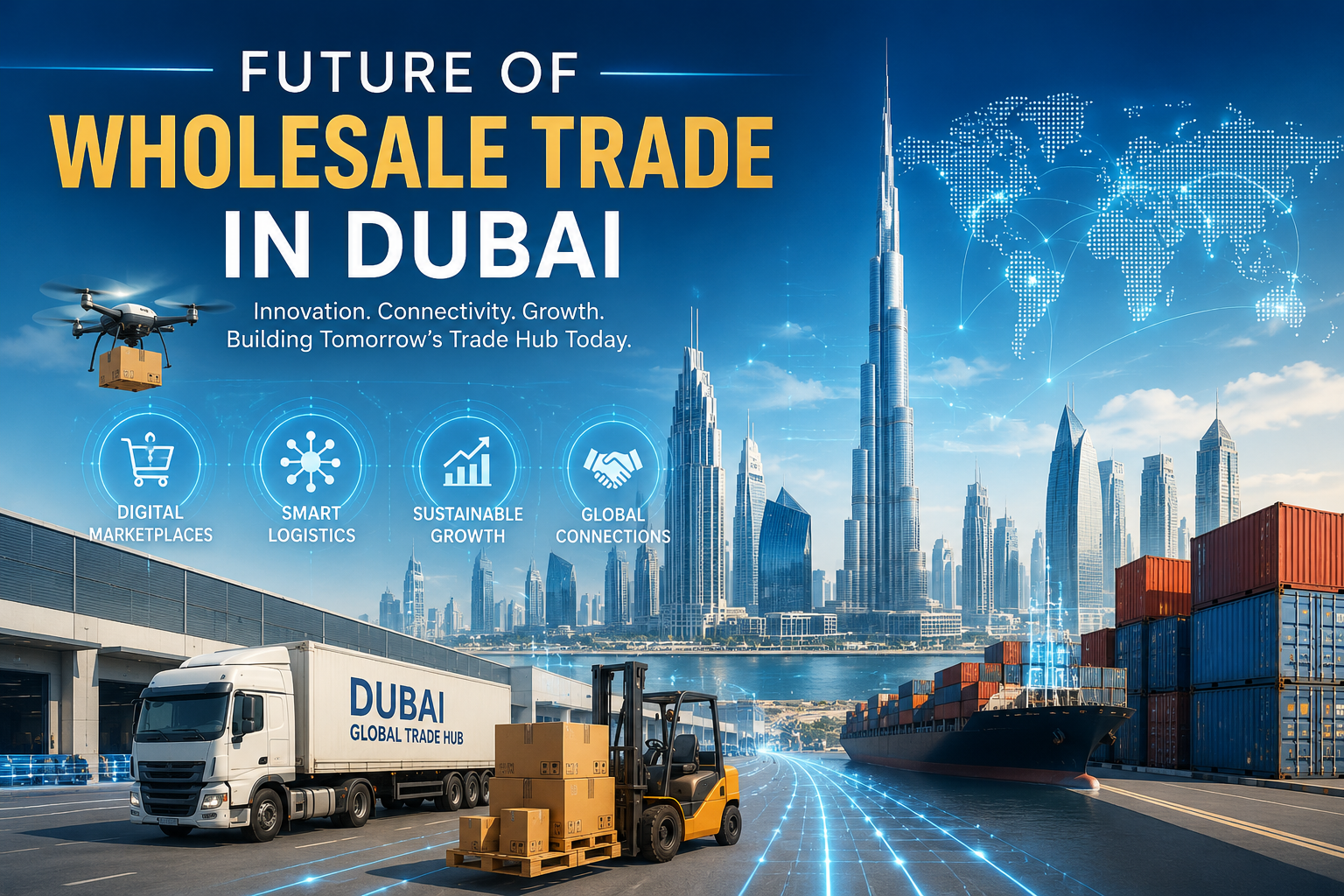
Future of Wholesale Trade in Dubai: Trends, Opportunities and Growth
Dubai has established itself as one of the world’s leading business and trading destinations. Its strategic location between Asia, Europe, Africa, and the Middle East, combined with modern ports, airports, warehouses, free zones, and advanced logistics infrastructure, makes it an important center for wholesale trade.
The future of wholesale trade in Dubai looks increasingly digital, technology-driven, flexible, and connected to international markets. Wholesale businesses are changing the way they source products, manage inventory, communicate with buyers, and deliver goods.
In 2026, e-commerce, artificial intelligence, digital customs, supply-chain resilience, and faster logistics are becoming important parts of the wholesale industry. Dubai Customs reported strong growth in air-cargo activity during the first half of 2026, including 18.2 million customs transactions and more than 6.2 million postal parcels, highlighting the growing connection between digital commerce and logistics.
For wholesalers, importers, exporters, retailers, and international buyers, understanding these changes can help identify new opportunities and prepare for the future.
1. Digital Wholesale Trade Will Continue to Grow
One of the biggest changes shaping the future of wholesale trade in Dubai is digital transformation.
Traditional wholesale businesses have often depended on physical markets, personal relationships, phone calls, and face-to-face negotiations. These methods remain valuable, but digital platforms are making wholesale sourcing faster and more convenient.
Buyers can increasingly search for products online, compare suppliers, request quotations, communicate with sellers, and manage orders digitally.
This is especially useful for international buyers who cannot visit Dubai regularly. Digital wholesale platforms allow businesses to research suppliers and products before making purchasing decisions.
As online business tools become more advanced, wholesalers that offer digital ordering and communication may have an advantage in attracting local and international customers.
2. E-Commerce Will Shape Wholesale Demand
E-commerce is expected to remain one of the strongest drivers of wholesale demand.
Online stores, marketplace sellers, and social media businesses need a continuous supply of products. Unlike traditional retailers, many online sellers may require smaller quantities, frequent restocking, and fast delivery.
This creates opportunities for Dubai wholesale suppliers that can provide flexible order quantities and efficient fulfillment.
Dubai Customs has reported strong growth in e-commerce-related shipments. During the first half of 2026, its Free Zone Department handled more than 6.2 million postal parcels, demonstrating the increasing scale of digital trade and small-shipment activity.
This trend is likely to encourage wholesalers to develop services specifically for online sellers.
3. Artificial Intelligence Will Transform Wholesale Operations
Artificial intelligence is becoming an important part of Dubai’s trade and logistics ecosystem.
AI can help businesses analyze purchasing patterns, forecast demand, monitor inventory, identify potential supply-chain problems, and improve customer service.
Dubai Customs is already developing AI-powered systems to improve customs readiness and risk management. Its Advance Cargo Information initiative is designed to analyze shipment information before goods arrive, while other AI solutions are being developed to support decision-making and operational efficiency.
For wholesale businesses, similar technologies can eventually make inventory planning and order management more efficient.
AI will not simply be a technology for large corporations. As digital tools become more affordable, smaller wholesale companies may also benefit from automated business solutions.
4. Smart Customs Will Make Trade More Efficient
Customs procedures are an important part of international wholesale trade.
Faster and more predictable customs clearance can help businesses reduce delays and improve supply-chain efficiency.
Dubai is investing in smart customs technologies to make the movement of goods more efficient. Digital systems can improve shipment visibility, risk assessment, inspection processes, and communication between businesses and authorities.
Dubai Customs has also been developing smart monitoring solutions such as Shahin, which provides real-time tracking of trucks and cargo across customs entry points.
These developments can make Dubai more attractive to businesses that depend on fast and reliable international trade.
5. Logistics Will Remain a Major Competitive Advantage
The future of wholesale trade in Dubai will remain closely connected to logistics.
Wholesalers need efficient transportation to move products from ports and airports to warehouses, retailers, distributors, and international destinations.
Dubai’s combination of sea, air, and road transportation gives businesses multiple options for moving goods.
The importance of logistics became especially clear in 2026, when Dubai strengthened alternative trade routes and logistics arrangements to maintain the movement of goods during regional disruptions.
For wholesale businesses, efficient logistics can mean faster deliveries, lower operational risks, and better customer satisfaction.
6. Warehousing Demand Will Increase
As wholesale and e-commerce activity grows, demand for warehouses and distribution facilities is also expected to increase.
Modern warehouses are no longer simply storage locations. Businesses increasingly use them for inventory management, order preparation, packaging, product consolidation, and distribution.
Strategically located warehouses can help wholesalers deliver products faster to customers across Dubai and other markets.
The continued investment in Dubai’s trade and industrial infrastructure indicates that warehousing will remain an important part of the wholesale ecosystem.
7. Free Zones Will Support International Wholesale Trade
Dubai’s free zones are expected to remain important for businesses involved in importing, exporting, manufacturing, logistics, and distribution.
Free-zone locations can provide businesses with access to established infrastructure and international trading networks.
Jebel Ali Free Zone, for example, continues to attract investment across manufacturing, logistics, food production, healthcare, vehicle handling, and other sectors. DP World reported AED 854 million in investments at Jafza during the first four months of 2026.
For international wholesalers, free zones can therefore remain an important option when planning regional distribution operations.
8. Cross-Border Wholesale Trade Will Expand
Dubai’s geographical location gives it a natural advantage in cross-border trade.
Businesses can use Dubai as a regional distribution center for markets in the Middle East, Africa, Asia, and beyond.
Instead of maintaining separate sourcing operations in multiple locations, companies may use Dubai to consolidate products, store inventory, and distribute goods to several markets.
This can be particularly useful for wholesalers dealing with consumer goods, electronics, fashion, construction products, food products, machinery, and other internationally traded categories.
9. Supply-Chain Resilience Will Become Essential
Future wholesale businesses will need to prepare for unexpected disruptions.
Global trade can be affected by geopolitical developments, transportation problems, shipping disruptions, changing regulations, and fluctuations in costs.
For this reason, businesses are increasingly looking at supply-chain resilience.
A resilient wholesale operation may include:
- Multiple suppliers
- Alternative shipping routes
- Local inventory
- Reliable logistics partners
- Better demand forecasting
- Flexible warehousing
- Emergency stock planning
Dubai’s response to trade disruptions in 2026 demonstrated the importance of maintaining alternative routes and flexible logistics systems.
10. Buyers Will Demand Better Product Quality
Price will continue to matter, but product quality is becoming equally important.
Retailers and online sellers do not want products that generate frequent returns or customer complaints.
Wholesale buyers are therefore likely to pay more attention to:
- Product specifications
- Materials
- Certifications
- Packaging
- Manufacturing standards
- Product consistency
- Supplier reputation
Wholesalers that maintain consistent quality can build stronger long-term relationships with retailers and distributors.
In the future, suppliers will need to provide both competitive prices and dependable quality.
11. Supplier Transparency Will Become More Important
As wholesale sourcing becomes more digital, buyers will want more information about suppliers.
Businesses may increasingly check supplier history, product information, certifications, warehouse facilities, customer reviews, and business credentials before placing large orders.
Transparency can help wholesalers build trust with international customers.
A professional supplier should be able to clearly explain product specifications, minimum order quantities, payment terms, delivery arrangements, and return or replacement policies.
Trust will remain one of the most valuable assets in wholesale trade.
12. Small and Medium Businesses Will Gain More Opportunities
The future of wholesale trade in Dubai is not limited to large corporations.
Small and medium-sized businesses are increasingly participating in wholesale purchasing through online stores, social commerce, marketplaces, and local retail businesses.
Digital platforms can reduce some of the traditional barriers to finding suppliers.
A small business may begin with a relatively small order and increase purchasing volume as its sales grow.
This creates an opportunity for wholesalers that offer flexible order sizes and services designed for smaller businesses.
13. Flexible Minimum Order Quantities Will Matter
Traditional wholesale models often focus on large bulk orders.
However, the growth of online businesses is creating demand for more flexible purchasing options.
Small retailers and online sellers may not have enough storage space or capital to purchase huge quantities.
Wholesalers that provide reasonable minimum order quantities can attract a wider range of customers.
Flexible purchasing can also help new businesses test products before investing heavily in inventory.
This trend could make Dubai’s wholesale market more accessible to startups and smaller retailers.
14. Faster Delivery Will Become a Key Selling Point
Customers increasingly expect quick delivery, and this expectation affects the entire supply chain.
Retailers need products when they need them. Online businesses can lose sales when popular products are out of stock.
As a result, wholesalers that can provide fast and reliable delivery may have a strong competitive advantage.
Dubai’s extensive logistics infrastructure can support this requirement by connecting warehouses, ports, airports, and markets.
In the future, delivery speed may become almost as important as product price for many wholesale buyers.
15. Data-Driven Inventory Management Will Grow
Inventory management is one of the biggest challenges for wholesale businesses.
Keeping too much stock can increase storage costs, while keeping too little can lead to shortages.
Technology can help businesses analyze previous sales, seasonal demand, customer behavior, and purchasing patterns.
Data-driven inventory management can help wholesalers decide:
- Which products to stock
- How much inventory to purchase
- When to reorder
- Which products are selling slowly
- Which items are becoming more popular
This can reduce waste and improve cash-flow management.
16. Sustainability Will Influence Wholesale Businesses
Sustainability is becoming increasingly relevant in international business.
Retailers and consumers are paying greater attention to packaging, materials, waste, and responsible sourcing.
Wholesale businesses may respond by reducing unnecessary packaging, improving warehouse efficiency, using more sustainable materials, and working with responsible suppliers.
Sustainable practices can also help companies meet the expectations of international buyers.
Although sustainability may not replace price and quality as major purchasing factors, it is likely to become an increasingly important part of supplier selection.
17. Customer Service Will Become a Strong Differentiator
As competition increases, wholesalers will need to offer more than products.
Professional customer service can make a significant difference in long-term wholesale relationships.
Buyers want suppliers who respond quickly, provide accurate information, communicate delivery updates, and resolve problems efficiently.
Strong customer service can encourage repeat orders and improve customer loyalty.
In the future, wholesalers that combine competitive pricing with professional support may have a stronger position in the market.
18. Dubai Will Strengthen Its Regional Distribution Role
Dubai’s future wholesale market is closely connected with its role as a regional distribution hub.
The city provides businesses with access to international transportation networks, logistics companies, warehouses, free zones, customs facilities, and a large commercial ecosystem.
Dubai Customs’ continued investment in digital trade and logistics supports the emirate’s goal of strengthening its role as a global trade hub. Its Center of Excellence for Customs and Trade Logistics is also focused on research, innovation, supply-chain resilience, and digitally enabled customs systems.
This combination of infrastructure and innovation can support wholesale businesses targeting multiple international markets.
19. Competition Will Push Wholesalers to Improve
The Dubai wholesale market is becoming increasingly competitive.
More suppliers mean buyers have more choices, which encourages businesses to improve their services.
Future wholesale companies may compete through:
- Better pricing
- Higher product quality
- Faster delivery
- Better customer service
- Digital ordering
- Wider product ranges
- Flexible order quantities
- Reliable stock
- Strong supplier relationships
Wholesalers that fail to adapt may find it harder to compete.
On the other hand, businesses that understand changing buyer expectations can use these developments to build long-term advantages.
20. What Does the Future of Wholesale Trade in Dubai Look Like?
The future of wholesale trade in Dubai is likely to be more connected, digital, technology-driven, and customer-focused.
Traditional wholesale markets will continue to serve buyers who prefer physical product inspection and direct negotiation. At the same time, online platforms will make supplier discovery and ordering faster.
Artificial intelligence can improve forecasting and customs operations, while smart logistics can increase shipment visibility and speed. E-commerce will continue generating demand for flexible wholesale solutions, and free zones will remain important for international trade.
Dubai’s ability to maintain trade flows during periods of disruption also highlights the importance of resilience and flexibility. UAE trade leaders surveyed by DP World showed strong confidence in 2026 trade growth, with businesses emphasizing supplier diversification, route options, and investment in logistics capacity.
For wholesalers and buyers, the future will therefore depend on adaptation.
Companies that invest in technology, reliable suppliers, efficient logistics, strong customer service, and quality products can be better positioned to benefit from Dubai’s expanding wholesale economy.
Conclusion
The future of wholesale trade in Dubai presents significant opportunities for businesses of different sizes.
Digital wholesale platforms, e-commerce, artificial intelligence, smart customs, modern warehouses, free zones, and advanced logistics are changing how products move through the market.
At the same time, buyers are becoming more demanding. They want reliable suppliers, consistent product quality, competitive prices, flexible order quantities, fast delivery, and professional customer service.
Dubai’s strategic location and strong trade infrastructure give it an important advantage in connecting international markets. Continued investment in digital customs, logistics, technology, and supply-chain resilience is likely to strengthen this position further.
For businesses planning to enter or expand in the Dubai wholesale market, the key is to stay informed and adapt to changing market expectations.
The wholesale businesses that embrace technology, build reliable supply chains, focus on customer needs, and provide consistent value will be in a stronger position to succeed in Dubai’s evolving trade environment throughout 2026 and beyond.