
Buying Guide for 2026
Finding the right communication equipment supplier is an important step for businesses that rely on fast, reliable communication. Walkie-talkies are widely used in security operations, construction projects, warehouses, hotels, shopping malls, event management, logistics, and industrial facilities. For businesses that need multiple devices, purchasing in bulk can help manage costs and maintain consistent equipment across teams.
The Walkie-Talkie Wholesale Market in Dubai offers business buyers an opportunity to explore different communication devices, compare product specifications, and source equipment for various commercial applications. However, choosing the right supplier involves more than finding the lowest price. Buyers must also consider product quality, battery performance, communication range, compatibility, warranty coverage, and UAE regulatory requirements.
Whether you operate a security company, manage a warehouse, supply communication equipment, or run a retail business, understanding the wholesale purchasing process can help you make informed decisions.
This buyer’s guide explains the types of walkie-talkies available, where to source them, how to compare suppliers, and what to check before placing a bulk order.
Why Buy Walkie-Talkies Wholesale in Dubai?
Dubai is an established commercial trading centre connecting suppliers, distributors, retailers, and international buyers. Businesses sourcing communication equipment can compare different product categories and discuss bulk purchasing arrangements with suppliers.
Buying wholesale may offer several practical benefits.
1. More Competitive Bulk Pricing
Wholesale suppliers may offer different price levels depending on order quantity, model, accessories, and brand. Purchasing several units together can sometimes reduce the per-unit cost compared with buying individual devices.
However, bulk pricing varies between suppliers. Always request a written quotation that includes the device, battery, charger, accessories, warranty, and applicable taxes.
2. Access to Different Product Types
Business buyers may need basic handheld radios for short-range communication or more advanced devices for demanding environments. Wholesale suppliers can help buyers compare available models according to their operational requirements.
Depending on the supplier, available options may include compact handheld radios, professional two-way radios, vehicle-mounted units, compatible repeaters, headsets, and charging accessories.
3. Convenient Sourcing for Multiple Industries
Businesses with large teams often need several compatible devices at once. Purchasing from one supplier can simplify procurement, documentation, accessory selection, and after-sales support.
For example, a security company may require identical radios for guards working across multiple locations. A warehouse may need separate communication devices for supervisors, inventory staff, and loading teams.
4. Opportunities for Resellers
Retailers and communication equipment distributors can explore wholesale purchasing to develop their product range. Before committing to a large order, they should check customer demand, available margins, minimum order quantities, and the supplier’s ability to provide repeat stock.
Types of Walkie-Talkies Available for Wholesale
Before contacting suppliers, understand the main product categories and how they differ.
1. Basic Handheld Walkie-Talkies
Basic handheld radios are designed for straightforward, short-range communication. They may suit small retail teams, event staff, temporary work sites, and other applications where simple push-to-talk communication is sufficient.
When evaluating these devices, check their battery capacity, charging time, audio clarity, physical durability, and permitted operating frequencies.
Do not assume that every low-cost radio can legally operate on every advertised channel in the UAE.
2. Professional Two-Way Radios
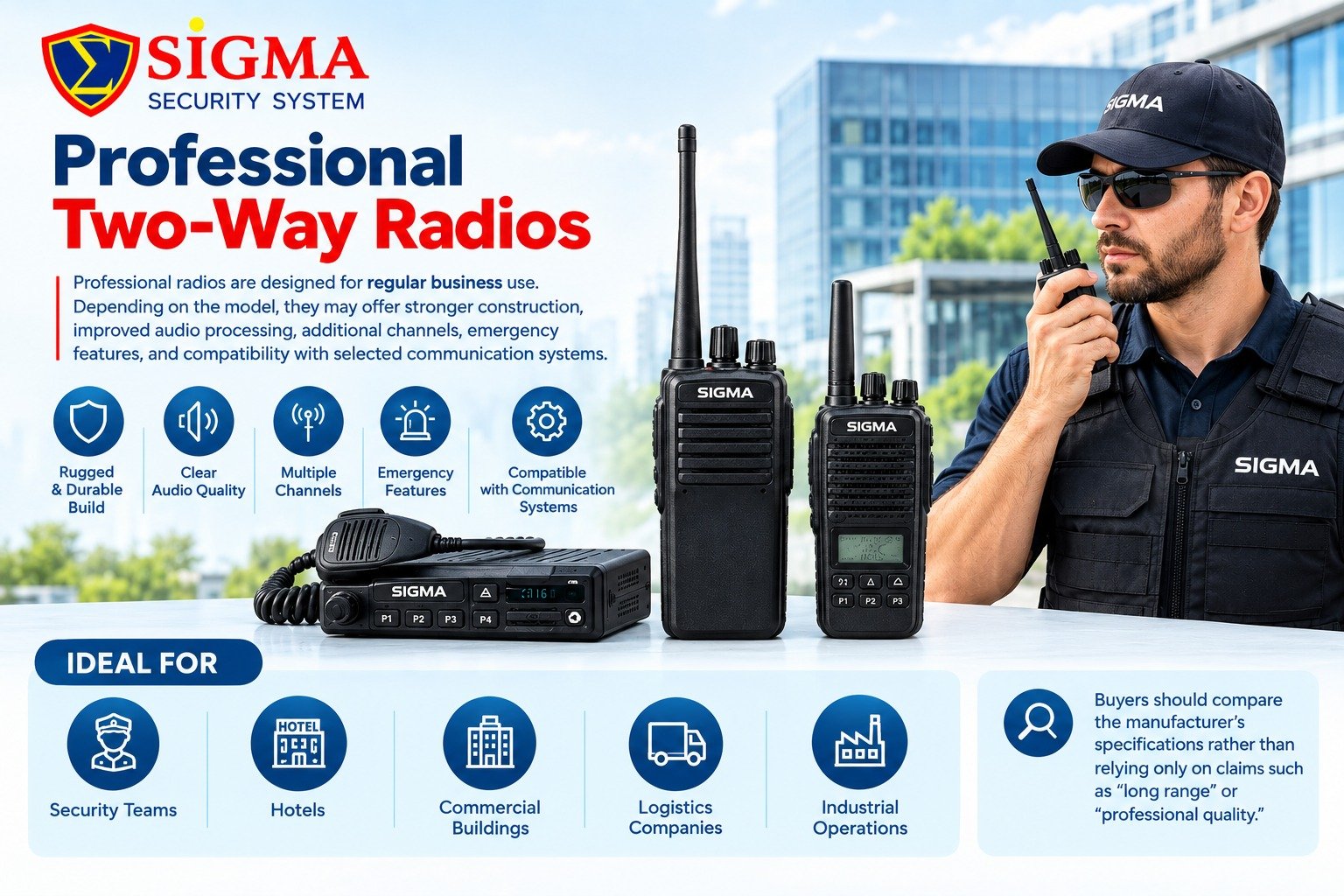
Professional radios are designed for regular business use. Depending on the model, they may offer stronger construction, improved audio processing, additional channels, emergency features, and compatibility with selected communication systems.
These devices may be suitable for security teams, hotels, commercial buildings, logistics companies, and industrial operations.
Buyers should compare the manufacturer’s specifications rather than relying only on claims such as “long range” or “professional quality.”
3. Digital Walkie-Talkies
Digital radios convert voice into digital signals and can offer features such as clearer audio under suitable conditions, group calling, private calling, and improved channel management, depending on the technology and model.
Some digital radios support additional operational features, but compatibility must be checked carefully. Two digital devices will not necessarily communicate with each other simply because they use the same brand or frequency band.
Confirm the supported digital standard, programming requirements, and compatibility with any existing equipment.
4. Heavy-Duty Radios for Industrial Use
Construction sites, factories, warehouses, and outdoor work environments may require radios designed to tolerate regular handling and challenging conditions.
Look for specifications covering impact resistance, dust protection, water resistance, operating temperature, and battery performance.
If a supplier advertises an IP rating, verify the exact rating and the conditions under which the device was tested.
5. Long-Range Communication Systems
Some businesses need communication across large facilities, multiple floors, or extensive outdoor sites. Depending on the environment, suitable solutions may involve professional radios, approved repeaters, or other authorised communication infrastructure.
A longer advertised range does not guarantee better real-world performance. Buildings, concrete walls, metal structures, terrain, antenna placement, and interference can reduce coverage.
Ask the supplier whether the proposed system has been assessed for your actual operating environment.
Where to Find a Walkie-Talkie Wholesale Market in Dubai
When searching for the Walkie-Talkie Wholesale Market in Dubai, buyers should consider specialist communication equipment suppliers, established electronics wholesalers, and authorised distributors.
Rather than selecting a supplier based only on a marketplace listing, compare several businesses and verify their suitability for commercial purchasing.
1. Specialist Communication Equipment Suppliers
Specialist suppliers focus on two-way radios and related communication products. They may be able to explain the differences between analogue and digital radios, recommend compatible accessories, and provide technical support.
Ask whether they can supply the required quantity, demonstrate the equipment, provide documentation, and assist with programming or installation where necessary.
2. Electronics Wholesalers
Electronics wholesalers may offer walkie-talkies alongside security equipment, cables, chargers, batteries, and other electronic products.
This option may be convenient for retailers and trading companies that source multiple product categories from one supplier.
However, confirm whether the supplier has suitable technical knowledge and can provide the necessary product documentation and after-sales assistance.
3. Authorised Brand Distributors
Purchasing through an authorised distributor may help buyers verify product authenticity and access manufacturer-backed warranty arrangements.
If you have a preferred brand, check its official website for distributor information or contact the manufacturer to verify the seller’s status.
You can also explore the manufacturer’s technical documentation to compare models before requesting a quotation.
4. Online Wholesale Suppliers
Online catalogues can help buyers compare specifications, identify potential suppliers, and request quotations before visiting a showroom.
However, product photographs and descriptions are not enough to establish quality or regulatory compliance. Ask for the exact model number, technical datasheet, warranty terms, and written confirmation of what is included.
For large orders, consider inspecting a sample before approving the full shipment.
How to Choose the Right Wholesale Supplier
Selecting a supplier requires evaluating several factors beyond the initial price.
Product Authenticity and Quality
Check the manufacturer’s name, exact model number, packaging, serial numbers, and supporting documentation. Be cautious if a supplier cannot identify the product’s manufacturer or provides inconsistent specifications.
Where possible, request a sample unit and test it before ordering in bulk.
Wholesale Prices and Minimum Order Quantity
Ask suppliers to provide quotations for different quantities, such as 10, 25, 50, or 100 units, where those quantities are relevant to your business.
Compare the total purchase cost rather than only the unit price. Additional batteries, programming, chargers, delivery, and warranty arrangements can change the final cost.
There is no single wholesale price for all walkie-talkies. Costs depend on brand, model, technical features, order size, and included accessories.
Warranty and After-Sales Service
Communication equipment may require replacement batteries, repairs, programming, or technical assistance during its working life.
Before ordering, ask:
- How long is the warranty?
- What types of defects are covered?
- Is the warranty handled locally?
- Are replacement batteries and accessories available?
- Is technical support available for programming and compatibility issues?
Get the answers in writing.
Delivery and Stock Availability
Confirm whether the supplier has the requested quantity in stock and obtain an estimated delivery date.
If your business operates across several sites, discuss packaging, delivery arrangements, and the possibility of receiving all units from the same model batch.
For international orders, also clarify export documentation, shipping costs, customs requirements, and responsibility for import compliance.
Business Documentation
Commercial buyers should request a formal quotation and invoice, along with relevant business and product documentation.
For regulated telecommunications equipment, check the supplier’s status and the device’s approval requirements with the relevant UAE authority.
The UAE’s Telecommunications and Digital Government Regulatory Authority (TDRA) publishes information about telecommunications equipment registration and approval.
Important Features to Check Before Buying in Bulk
The right specifications depend on your work environment and the number of people who need to communicate.
Communication Range
Check the manufacturer’s stated range, but treat it as a specification rather than a guarantee. Ask whether the range relates to open terrain or a built-up environment.
For hotels, warehouses, and shopping malls, test the devices in the actual building if possible.
Battery Life
Battery performance affects how reliably employees can communicate throughout a shift.
Compare battery capacity, rated operating time, charging time, replacement availability, and the manufacturer’s testing conditions.
Businesses operating long shifts may benefit from spare batteries or additional charging stations.
Frequency and Compatibility
Frequency compatibility is essential. Confirm that the proposed radios are suitable for use in the UAE and compatible with your existing equipment.
If you are expanding an existing fleet, provide your supplier with the exact model numbers and system details. Do not assume that radios operating on similar frequencies will communicate without compatible settings and authorisation.
Audio Quality
Clear audio can help reduce misunderstandings in busy workplaces.
Where possible, test the speaker volume, microphone quality, background-noise handling, and voice clarity in the environments where the radios will be used.
Durability and Ease of Use
Consider the device’s weight, button layout, display, grip, and resistance to dust or moisture.
A radio that is difficult to operate with gloves or uncomfortable to carry throughout a shift may not be suitable for your team.
Accessories
Check which accessories are included and which must be purchased separately. Common options include:
- Spare batteries
- Charging docks and multi-unit chargers
- Earpieces and headsets
- Belt clips and carrying cases
- Approved antennas
- Compatible microphones
- Repeaters and related infrastructure, where required
Always confirm that accessories are compatible with the exact radio model.
UAE Regulations: What Buyers Should Know
Regulatory compliance is an important part of purchasing and reselling walkie-talkies.
Radio equipment may be subject to technical approval, frequency restrictions, or authorisation requirements depending on the device and how it will be used.
The TDRA provides the relevant framework and information through its official regulations and rulings.
Before purchasing, importing, selling, or operating a radio system, take these steps:
- Identify the exact manufacturer and model.
- Confirm whether the equipment requires TDRA registration or type approval.
- Check the permitted frequency band and applicable technical conditions.
- Determine whether the intended use requires a separate radio-frequency or wireless authorisation.
- Confirm any import or customs documentation requirements.
- Keep invoices, datasheets, and relevant approval documents.
The TDRA’s Private Mobile Radio regulations provide additional information on private mobile radio systems.
Requirements can differ between equipment categories. Do not assume that a radio permitted in another country can automatically be used in the UAE.
Which Industries Need Wholesale Walkie-Talkies?
Bulk communication equipment can support several business sectors.
Security Companies
Security personnel use radios to coordinate patrols, communicate incidents, and stay connected with supervisors.
Companies should prioritise reliable audio, suitable coverage, durable construction, battery performance, and compatible accessories.
Construction Companies
Construction teams may use radios to coordinate workers, equipment operators, site supervisors, and delivery vehicles.
The selected equipment should suit the site’s size, environmental conditions, and communication requirements.
Hotels and Hospitality
Hotels, resorts, and hospitality venues may use radios for housekeeping, maintenance, front-desk coordination, and event operations.
Compact devices, discreet earpieces, and practical charging arrangements may be useful in these environments.
Warehouses and Logistics
Warehouse teams can use radios to coordinate picking, packing, loading, stock movement, and dispatch.
Before selecting equipment, evaluate coverage across storage racks, loading bays, office areas, and other operational zones.
Event Management
Event organisers may need radios for staff coordination, crowd management, technical teams, and logistics.
The required number of devices depends on the event size, team structure, communication plan, and permitted operating arrangements.
Retail Stores and Shopping Malls
Retail teams may use walkie-talkies to communicate about customer assistance, stock availability, security concerns, and daily operations.
The ideal system depends on the building layout, number of users, and required coverage.
How to Compare Wholesale Quotations
When you receive quotations from several suppliers, compare them using the same requirements.
| Comparison factor | What to verify |
|---|---|
| Unit price | Price at your required quantity |
| Minimum order | Supplier’s minimum purchase quantity |
| Model | Exact manufacturer and model number |
| Accessories | Batteries, chargers, clips, and headsets |
| Compatibility | Frequency, standard, and programming |
| Warranty | Duration, coverage, and repair arrangements |
| Compliance | Applicable approvals and documentation |
| Delivery | Stock availability, lead time, and charges |
| Payment | Deposit, balance, and payment terms |
A low quotation may exclude essential accessories or offer limited warranty coverage. A higher quotation may include technical support or additional equipment.
Use the total cost of ownership to compare offers fairly.
Common Mistakes to Avoid When Buying Wholesale
Even experienced buyers can make costly purchasing decisions if they overlook technical or commercial details.
Choosing the lowest price without checking specifications: Low-cost equipment may not meet the required performance, durability, or compliance standards.
Assuming every radio is compatible: Devices may use different frequencies, protocols, channel configurations, or programming.
Ignoring local regulations: Verify approval and operating requirements before placing an order.
Ordering too many units before testing: A sample order or product demonstration can help identify practical problems before a larger purchase.
Overlooking spare parts: Confirm the availability of batteries, chargers, and replacement accessories.
Accepting unclear warranty terms: Ask for written warranty conditions and a clear procedure for defective units.
Failing to plan for future expansion: Consider whether additional radios can be integrated into the proposed system without unnecessary replacement costs.
Step-by-Step Wholesale Buying Process
Follow this practical process to organise your purchase.
- Define your requirements. Identify the industry, number of users, operating environment, required coverage, and expected working hours.
- Select suitable specifications. Decide whether basic handheld radios or a professional communication system is appropriate.
- Contact multiple suppliers. Request comparable quotations from specialist suppliers, authorised distributors, and relevant electronics wholesalers.
- Verify compliance. Check the applicable TDRA requirements and any necessary authorisations.
- Test a sample. Evaluate audio quality, coverage, battery performance, and ease of use.
- Negotiate the order. Confirm quantity, pricing, accessories, payment terms, and delivery.
- Document the agreement. Obtain a formal quotation, invoice, warranty terms, and relevant technical documents.
- Inspect the delivery. Check quantities, model numbers, accessories, and any visible damage before distributing the radios to your team.
Following these steps can help reduce purchasing risks and make supplier comparisons more straightforward.
Is Buying Walkie-Talkies Wholesale in Dubai Suitable for Your Business?
The Walkie-Talkie Wholesale Market in Dubai can be a useful sourcing option for businesses that need multiple communication devices, accessories, or equipment for resale.
However, the right purchasing decision depends on your business requirements. A small retail shop may need only a few basic radios, while a large warehouse or security operation may require a more advanced communication system.
Before committing to a supplier, compare product specifications, total costs, warranty coverage, stock availability, and compliance documentation. Testing the equipment in your actual working environment can also help you avoid selecting a model that does not meet your needs.
For resellers, it is equally important to evaluate customer demand, repeat-stock availability, and the commercial terms offered by the supplier.
Frequently Asked Questions (FAQs)
1. Where can I buy walkie-talkies wholesale in Dubai?
You can approach specialist communication equipment suppliers, electronics wholesalers, and authorised distributors. Compare several suppliers and verify their products, business documentation, warranty arrangements, and compliance requirements before purchasing.
2. What is the minimum order quantity for wholesale walkie-talkies?
The minimum order quantity depends on the supplier and product. Some suppliers may accept small bulk orders, while others may require larger quantities. Ask for quotations at different order sizes.
3. How much do wholesale walkie-talkies cost in Dubai?
Prices vary according to brand, model, features, accessories, and order quantity. Request a written quotation for your specific requirements instead of relying on a general market price.
4. Are all walkie-talkies compatible with each other?
No. Compatibility depends on factors such as frequency, communication standard, channel configuration, programming, and regulatory restrictions. Check these details before purchasing additional radios for an existing fleet.
5. Do walkie-talkies require approval in the UAE?
Some telecommunications equipment is subject to TDRA registration, type approval, or other applicable requirements. The specific obligations depend on the device category and intended use. Consult the official TDRA guidance before importing, selling, or operating equipment.
6. Which walkie-talkies are suitable for security companies?
The choice depends on the site layout, required coverage, number of users, shift duration, and operating conditions. Security companies should evaluate audio clarity, battery performance, durability, and system compatibility before selecting a model.
7. Can I buy walkie-talkies wholesale for resale?
Yes, businesses can explore wholesale purchasing for resale, subject to applicable commercial and telecommunications requirements. Verify product authenticity, documentation, warranty support, and the supplier’s ability to provide repeat stock.
8. What should I check before placing a bulk order?
Confirm the model number, technical specifications, unit price, minimum order quantity, accessories, warranty, delivery terms, compatibility, and applicable regulatory approvals. Testing a sample is advisable when placing a substantial order.
Conclusion
Choosing the right communication equipment supplier requires careful research, technical comparison, and clear purchasing requirements. Dubai offers business buyers opportunities to source different types of two-way radios through specialist suppliers, electronics wholesalers, and authorised distributors.
When evaluating the Walkie-Talkie Wholesale Market in Dubai, focus on more than the purchase price. Product quality, communication range, battery life, compatibility, warranty support, and regulatory compliance all influence the long-term value of your investment.
By comparing quotations, testing samples, and verifying the supplier’s documentation, businesses can make more informed purchasing decisions and choose communication equipment suited to their operational needs.
Whether you are buying for security, construction, hospitality, logistics, retail, or resale, a structured sourcing process can help you manage costs and build a dependable communication system for your business.