
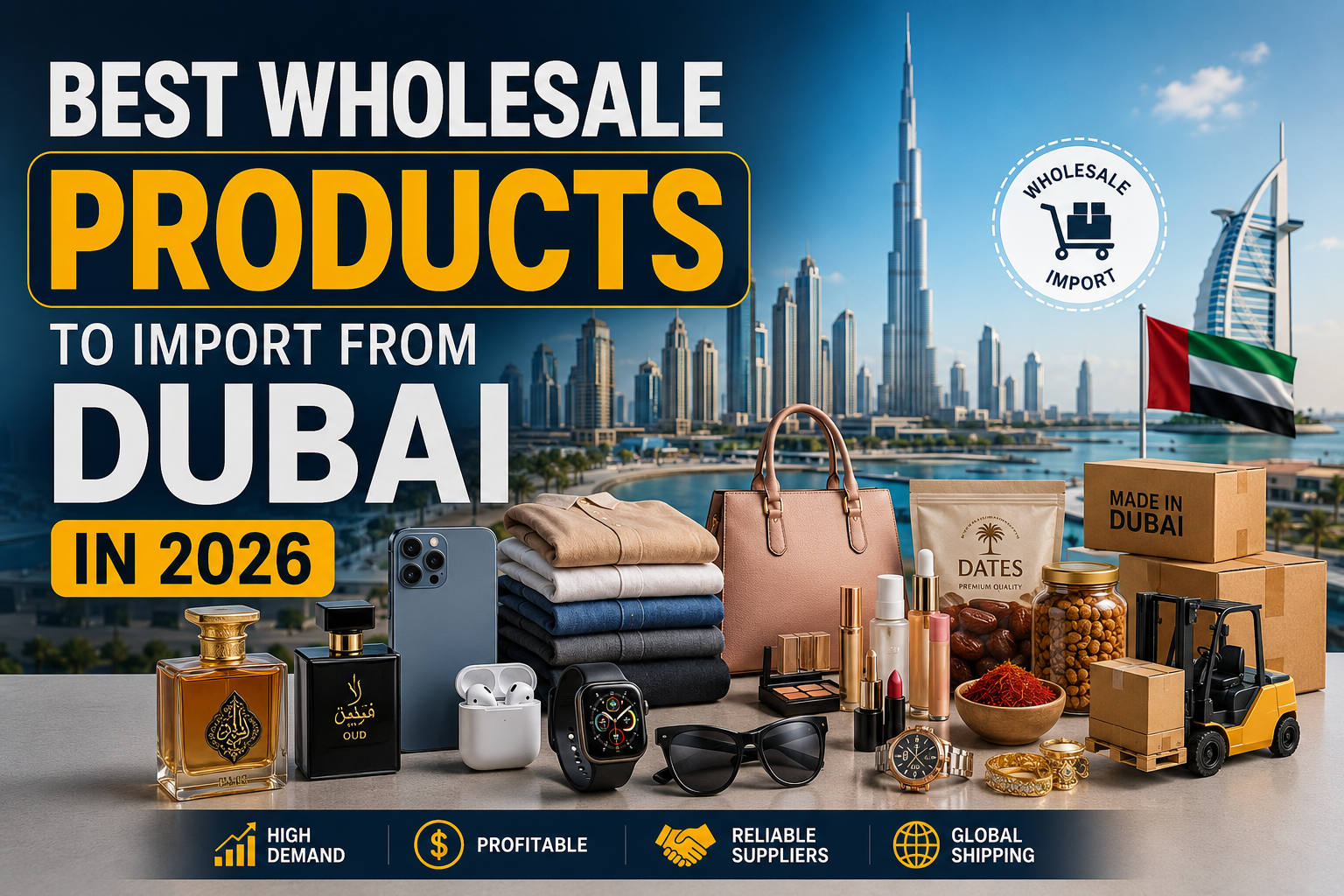
Best High-Demand Wholesale Products to Import from Dubai in 2026
Dubai has become one of the most important trading and re-export hubs between Asia, the Middle East, Africa, and South Asia. In 2026, the UAE’s non-oil foreign trade reached approximately AED 1.937 trillion in the first half of the year, up 13.1% year over year. (Government of Dubai Media Office)
If you are looking for the best wholesale products to import from Dubai in 2026, Dubai offers a wide range of products across electronics, perfumes, fashion, cosmetics, food, jewellery, automotive parts, and household goods. The city’s strong logistics infrastructure and international trading network make it an attractive sourcing destination for businesses around the world.
For international wholesalers and retailers, this makes Dubai an attractive sourcing location for products that can be purchased in bulk and then distributed to local or international markets.
But choosing the right wholesale products to import from Dubai is critical. Demand, purchase price, shipping costs, customs duties, product regulations, competition, shelf life, and potential profit margins should all be considered before placing a bulk order.
In this guide, we explore some of the best wholesale products to import from Dubai in 2026, along with their advantages and important sourcing considerations.
1. Consumer Electronics and Mobile Accessories

UAE trade data shows that telecommunications equipment is one of the country’s major import and re-export categories. In the first three quarters of 2025, telecommunications equipment represented 21.8% of re-exports. (Central Bank of the UAE)
Popular products include:
- Smartphones
- Tablets
- Laptops
- Bluetooth earbuds
- Smartwatches
- Power banks
- USB-C chargers
- Charging cables
- Phone cases
- Screen protectors
- Computer accessories
- Routers and networking equipment
Why import electronics from Dubai?
Electronics can offer high sales volume, particularly when targeting markets in Africa, South Asia, and the Middle East. Dubai also has established wholesale and logistics networks for electronics.
However, importers should verify product authenticity, model numbers, warranty conditions, certifications, and regional compatibility before purchasing large quantities.
2. Perfumes and Fragrances

Dubai is well known for Arabic perfumes, oud, attars, and other fragrance products. For retailers and distributors, perfumes can be among the best wholesale products to import from Dubai in 2026, particularly when suppliers offer competitive bulk pricing and authentic products
Dubai is strongly associated with Arabic perfumes, oud, attars, and luxury fragrances, making perfumes another attractive wholesale category.
Potential products include:
- Oud perfumes
- Attar
- Bakhoor
- Arabian fragrances
- Perfume oils
- Body sprays
- Home fragrances
- Gift perfume sets
The UAE’s trade statistics also identify perfumes among important non-oil export products, with perfume exports showing strong growth in recent trade data. (PDD Portal)
For wholesalers, fragrance products can be particularly attractive because they are relatively compact and can have significant retail markups.
Before importing, check the destination country’s rules for cosmetics, fragrance ingredients, labeling, packaging, and product registration.
3. Gold and Jewellery

Dubai has a long-established reputation as a major international gold and jewellery trading centre.
Gold remained the leading commodity in UAE non-oil trade during the first half of 2026, with reported trade value of approximately AED 706.2 billion. Gold jewellery also ranked among the country’s major commodities. (Government of Dubai Media Office)
Wholesale opportunities can include:
- Gold jewellery
- Gold-plated jewellery
- Silver jewellery
- Fashion jewellery
- Precious-stone jewellery
- Jewellery accessories
However, gold is different from many other wholesale categories. Importers must carefully consider:
- International gold prices
- Purity
- Making charges
- Currency exchange rates
- Import duties and taxes
- Certification
- Destination-country regulations
This category is generally better suited to experienced traders with sufficient working capital.
4. Fashion Clothing and Textiles

Fashion products are another popular category for international importers. Abbays, scarves, modest fashion, men’s clothing, women’s clothing, children’s clothing, and home textiles can provide opportunities for businesses targeting different customer segments
Clothing and textiles are another practical category for importers looking for products with broad consumer demand.
Possible wholesale products include:
- Abayas
- Modest fashion
- Men’s clothing
- Women’s clothing
- Children’s clothing
- Scarves
- Shawls
- T-shirts
- Workwear
- Hotel linen
- Bedsheets
- Towels
- Home textiles
Dubai’s position as a regional trading hub allows textile products sourced from countries such as India, China, Pakistan, and other manufacturing centres to be distributed throughout the region.
For importers, the best opportunities may be found in specialized niches rather than generic clothing, where price competition can be extremely high.
5. Beauty and Cosmetics Products

Beauty and personal-care products continue to attract consumers worldwide. Skincare, haircare, cosmetics, beauty tools, and salon products can also be considered when looking for the best wholesale products to import from Dubai in 2026..
Beauty products continue to attract strong demand across Middle Eastern and international markets.
Wholesale opportunities include:
- Skincare products
- Haircare products
- Makeup
- Facial cleansers
- Moisturizers
- Sunscreen
- Body-care products
- Beauty tools
- Salon supplies
- Personal-care products
Dubai’s wholesale ecosystem includes traditional markets as well as distributors and B2B suppliers serving retailers and businesses. (IbaadU)
Importers should pay particular attention to ingredients, expiry dates, batch numbers, labeling, product registration, and authenticity.
6. Food and FMCG Products

Food and FMCG products can be attractive because they have repeat-purchase demand.
Potential categories include:
- Rice
- Spices
- Pulses
- Dates
- Dry fruits
- Nuts
- Coffee
- Tea
- Packaged foods
- Snacks
- Cooking ingredients
- Beverages
- Canned foods
Dubai Customs reported that food products were the largest category moving through its Green Corridor during a 2026 period, with goods valued at more than AED 5.3 billion. (Government of Dubai Media Office)
For food imports, however, regulatory compliance is especially important. Check:
- Food labeling requirements
- Ingredients
- Country of origin
- Expiry dates
- Halal requirements where applicable
- Storage conditions
- Import permits
- Destination-country food regulations
7. Automotive Parts and Accessories

Dubai’s large automotive trading ecosystem makes auto parts and accessories another category worth considering.
Popular products include:
- Brake components
- Filters
- Car batteries
- Lights
- Wipers
- Engine components
- Car mats
- Seat covers
- Dash cameras
- Car cleaning products
- Exterior accessories
Automotive products can generate repeat business when wholesalers establish relationships with garages, spare-parts shops, dealerships, and fleet operators.
The key challenge is compatibility. Always verify the vehicle make, model, year, OEM number, specifications, and country requirements before ordering.
8. Building Materials and Hardware

Construction-related products can be suitable for B2B importers serving contractors and property-development markets.
Examples include:
- Electrical supplies
- Plumbing products
- Lighting
- Hardware
- Tools
- Tiles
- Sanitary fittings
- Aluminium products
- Steel products
- Construction accessories
Dubai Customs reported machinery and electrical equipment worth AED 4.24 billion moving through its Green Corridor during March–June 2026, while iron and steel products exceeded AED 1 billion. (Government of Dubai Media Office)
The major consideration here is logistics. Heavy products can quickly become expensive to ship, so importers should calculate landed cost per unit rather than focusing only on the Dubai wholesale price.
9. Home Décor and Household Products

Home décor can be an appealing category for retailers selling through physical stores or e-commerce.
Products can include:
- Decorative items
- Artificial flowers
- Lamps
- Wall décor
- Kitchen accessories
- Storage products
- Tableware
- Bathroom accessories
- Cushions
- Curtains
- Small furniture accessories
The advantage is the variety of products available at different price points. Importers can also target specific niches such as modern home décor, Arabic décor, budget household products, or hospitality supplies.
10. Industrial Machinery and Equipment
For B2B importers with established customers, industrial machinery and equipment can offer higher-value opportunities.
Potential categories include:
- Manufacturing machinery
- Packaging equipment
- Restaurant equipment
- Warehouse equipment
- Generators
- Electrical equipment
- Workshop machinery
- Industrial tools
- Material-handling equipment
This category typically requires more technical knowledge than consumer products. Buyers should verify specifications, spare-parts availability, installation requirements, warranties, and after-sales support.
11. Watches, Fashion Accessories and Lifestyle Products
Lifestyle products can work well for retailers targeting fashion-conscious consumers.
Potential products include:
- Watches
- Sunglasses
- Wallets
- Belts
- Bags
- Travel accessories
- Fashion jewellery
- Gift items
These products are generally easier to store and transport than bulky goods. However, wholesalers should avoid counterfeit branded products and work with legitimate suppliers.
How to Choose the Best Wholesale Products from Dubai
The best product isn’t necessarily the product with the highest retail price. It is the product that gives you a sustainable combination of demand, margin, manageable logistics, and regulatory compliance.
Before importing, evaluate these factors:
1. Market Demand
Research whether customers in your target country are actually buying the product.
2. Wholesale Price
Compare prices from multiple Dubai suppliers rather than accepting the first quotation.
3. Landed Cost
Calculate:
Product Cost + Dubai Handling + Shipping + Insurance + Customs + Taxes + Local Delivery = Landed Cost
This gives you a much more realistic picture of profitability.
4. Minimum Order Quantity
Some suppliers may require hundreds or thousands of units. Start with an MOQ that matches your available capital and sales capacity.
5. Product Regulations
Certain categories—including food, cosmetics, medicines, electronics, and chemicals—may have additional regulatory requirements.
6. Supplier Reliability
Verify the supplier’s business information, product quality, documentation, payment terms, and references before placing a large order.
7. Reorder Potential
Products with repeat demand can be more valuable than one-time trend products.
Before selecting the best wholesale products to import from Dubai in 2026, compare wholesale prices from different suppliers and calculate your complete landed cost. Product demand, minimum order quantities, customs duties, taxes, shipping expenses, and local competition can all affect your final profit.
Why Dubai Is Attractive for Wholesale Importers in 2026
Choosing the best wholesale products to import from Dubai in 2026 requires more than simply finding products at low prices. Importers should consider market demand, supplier reliability, wholesale prices, shipping costs, customs duties, product regulations, and potential profit margins before placing a bulk order.
Dubai’s biggest advantage is not simply the availability of products. It is the trading infrastructure surrounding those products.
The UAE recorded approximately AED 830.2 billion in re-exports during 2025, demonstrating the scale of its re-export economy. (PDD Portal)
Dubai also continues to support international trade through ports, airports, free zones, warehouses, customs services, logistics companies, distributors, and B2B trading networks.
This makes Dubai particularly useful for businesses that want to source products, consolidate shipments, and distribute goods into multiple regional markets.
At the same time, current regional disruptions demonstrate why importers should avoid relying on a single shipping route. Dubai Customs said its 2026 Green Corridor moved more than 203,242 containers and 3.16 million tonnes of goods from 188 countries between March and June, using measures intended to maintain trade flows and supply-chain continuity. (Government of Dubai Media Office)
Final Thoughts
The best wholesale products to import from Dubai in 2026 include consumer electronics, mobile accessories, perfumes, jewellery, clothing, cosmetics, food and FMCG products, automotive parts, building materials, home décor, and industrial equipment. The right choice ultimately depends on your target market, available budget, competition, and total landed cost.
However, product selection should always be based on your target market, available capital, shipping costs, competition, regulations, and expected profit margin.
For new importers, relatively easy-to-test categories such as mobile accessories, fashion products, perfumes, household products, and selected FMCG items can be a practical starting point. Experienced B2B traders may also explore higher-value categories such as machinery, automotive parts, electronics, and jewellery.
The key is not simply to find cheap products in Dubai—it is to find reliable suppliers and products that remain profitable after all import and distribution costs are included.
Before placing a large order, compare multiple suppliers, request product samples where appropriate, verify documentation, and calculate the total landed cost. This approach can help you select profitable Dubai wholesale products while reducing unnecessary import risks.